
Intel Shares Sink as PC Demand Dispels Recovery Hopes
Intel beat third-quarter estimates on record data-centre demand, then lost about 29% on Friday after issuing a weak PC outlook.
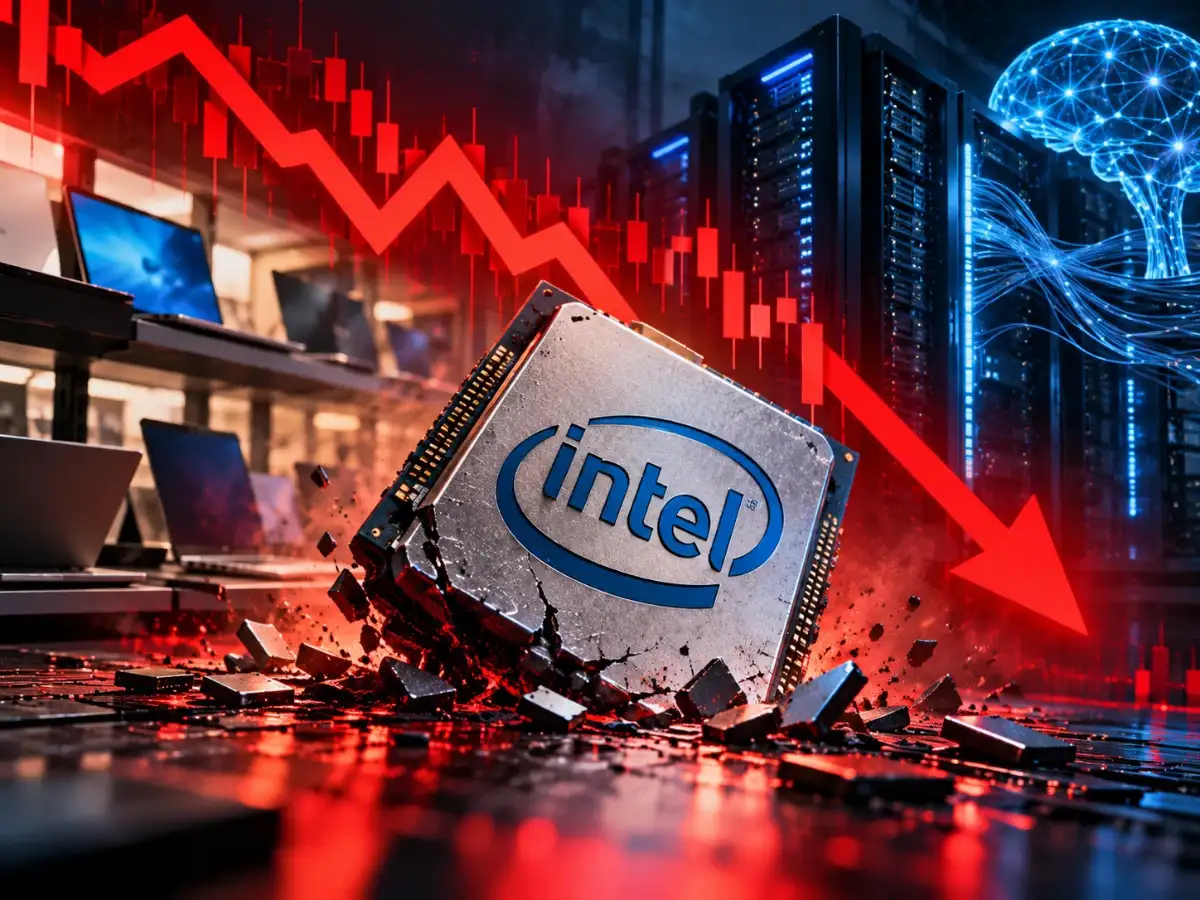
Intel reported better-than-expected third-quarter results on 29 October, then watched its shares lose roughly 29% by Friday's close in one of the semiconductor industry's sharpest single-day falls, after a weaker fourth-quarter outlook exposed how much of the industry's recent strength had depended on the personal-computer replacement cycle.
The move matters beyond one company's share register. Intel sits at the centre of the PC and server processor markets that corporate retreats still depend on, and its guidance is read as an early warning about where business demand for computing hardware is heading. For buyers in markets such as Nigeria, where most laptops and servers trace back to the same suppliers, the read from its guidance will shape equipment pricing over the next two quarters rather than the next two years.
A quarter of two markets
According to Intel's earnings release , third-quarter revenue was $16.5 billion, up 21% year on year, with non-GAAP earnings per share of $0.52 against analyst expectations of about $0.40, while chief financial officer David Zinsner noted the company's strongest data-centre revenue growth in fifteen years.
The detail beneath the aggregate was more uneven. Data-centre and AI revenue jumped 78% to $7.3 billion, and the foundry business grew 58% to $6.7 billion, but client computing revenue fell 5% to $8.1 billion and missed forecasts by roughly $700 million. Intel attributed the decline to a slow ongoing downgrade after last year's rush to replace Windows 10 machines, alongside rising memory prices pushing device costs higher.
That combination is worth understanding separately, because AI-driven infrastructure spending and workplace PC spending respond to different customers. Data-centre orders reflect the investment priorities of cloud providers with multi-year capital budgets. PC purchases reflect procurement decisions at thousands of companies, schools and shops, which can be deferred for several quarters once a replacement wave has passed.
The guidance that repriced the stock
Intel's fourth-quarter outlook was the problem the company could not simply communicate better on a conference call. It forecast revenue of between $15.0 billion and $16.0 billion and non-GAAP EPS of $0.25, both below analyst expectations of about $17.1 billion and $0.43 for revenue and per-share profit. Management estimated an explosion at one of its facilities in Israel, unrelated to the conflict, would cut about $300 million from the quarter, but even allowing for that, the gap was measured in billions rather than hundreds of millions.
Chief executive Lip-Bu Tan said Q3 results showed improving execution and robust demand for Intel's CPUs across the roadmap, and Zinsner said the company sees a PC market slowdown continuing at least through the first half of next year. That guidance is the trade-off investors were pricing in on Friday: the market had been treating Intel as a semiconductor turnaround story under a new management team, while the pullback in PC orders suggested the recovery in device demand was weaker than they believed.
What the sell-off means for the broader market
The reaction was not contained to Intel's own shares. Semiconductor names across Asia and the United States traded lower on Friday as investors reassessed valuations across the AI supply chain, and the sell-off in Intel now adds an infrastructure-driven leg to the industry's recent losses. Intel's stock had already fallen about 23% in October before the earnings reaction, making the move bigger but also less sudden.
For corporate buyers, two practical points stand out. First, device prices respond to component markets rather than vendor guidance, so a slowdown in demand can cut both ways on retail pricing, and second, companies replacing equipment need no longer expect last year's discounting, as PC component demand remains volatile and memory producers have shifted capacity away from PC DRAM, keeping input costs higher for longer.
Reading the signs for the next quarter
The quarter should be read alongside Intel's fundamentals rather than its share price. The company generated $5.1 billion in operating cash flow during the quarter, and its foundry business remains small relative to its product segments. Neither changes the immediate supply for commercial buyers. What changes is the currency in which Intel and its competitors can fund capacity and compete for customers in data centres, the segment growing fast enough to pull output off the shelf.
For Nigerian businesses and other emerging-market buyers, the practical consequences are slower hardware refresh decision making and more careful procurement leverage rather than a supply crunch. Devices remain available, but the vendors' scoreboard now gives weight to foundry momentum and PC-procurement delays, so buyers should expect slower price relief in the first half of 2027 compared with the second half of 2026.
Up next
bp Reports Sharper Quarterly Profit and Strong Cash Flow
bp more than doubled underlying third-quarter profit to $8.5 billion, with operating cash flow at $14.8 billion for the quarter.
More in Technology
See all
Airtel Africa Profit Rises as Data Demand Expands
Airtel Africa reports stronger half-year revenue and profit, with data demand growing and currency movements boosting dollar sales.

Amazon Cloud Growth Deepens Its Investment Challenge
Amazon reports faster AWS growth and stronger operating profit, while heavy AI investment pushes annual free cash flow below zero.

NCR Nigeria profit nearly doubles as equity deficit and cash outflow persist
Revenue and margins improved, but liabilities still exceeded assets and operations used cash during the nine months.
About the author
Kelechi Nwachukwu
Business Reporter
Kelechi Nwachukwu writes for BusinessPress.


