
US Moves To Terminate South Africa And Rwanda From AGOA From January 2027
President Trump notified Congress of intent to end duty-free AGOA access for South Africa and Rwanda from January 1, 2027, in a warning for all African exporters.
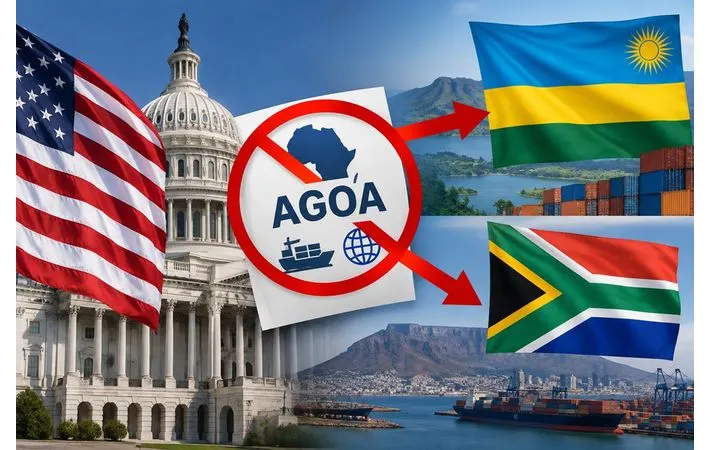
The United States has notified South Africa and Rwanda of its intention to terminate their eligibility for the African Growth and Opportunity Act from January 1, 2027, a closing of the continent's largest and most controversial trade-preference window that removes duty-free access for hundreds of exporters precisely as Washington's tariff walls rise higher — and it delivers a warning to Nigeria about the fragility of any trade advantage resting on Washington's discretion.
US Trade Representative Jamieson Greer announced the decision on Monday, saying President Donald Trump had notified Congress and both governments following an annual interagency eligibility review. "Based on the review, President Trump found that the governments of Rwanda and South Africa are engaging in practices that are inconsistent with AGOA's eligibility criteria," Greer said, citing barriers that undermine American trade and investment and practices that "pose a threat to US national security and foreign policy interests in the region." In South Africa's case, the administration is concerned by barriers to US trade and investment, corruption and the country's international alignments; in Rwanda's, by trade barriers, rule-of-law concerns, political pluralism, internationally recognised worker rights and human-rights issues.
What precisely is at stake
AGOA, enacted in 2000, grants eligible sub-Saharan African countries duty-free access to the American market for around 1,800 product lines, annually reviewed by USTR on eligibility criteria spanning market economy commitments, rule of law and worker rights. South Africa is the programme's largest beneficiary, exporting roughly $1.7 billion of goods under AGOA preferences in 2025 — about a tenth of its exports to the United States and 1 percent of its worldwide exports, according to Pretoria's own trade ministry figures, led by automobiles and automotive components, wine and agricultural products. Rwanda's exposure is smaller but strategically significant for apparel, horticulture and the craft export channels that AGOA helped seed.
The decision's unusual edge is timing. Congress only two months ago extended AGOA through December 31, 2028 — Public Law 119-103, signed on September 2 — and the president has now signalled terminations that would take effect fully two years before that expiry, effectively choosing first among beneficiaries to unwind programme benefits short of statutory reauthorisation. South Africa's trade department, in its first formal response, accused Washington of "introducing new issues" into negotiations that have run since 2025, saying Pretoria had offered additional concessions beyond those floated in 2015 while safeguarding constitutional obligations, biosecurity requirements and World Trade Organization commitments. Trump's notification letter of October 28 gave Ramaphosa's government 60 days' notice and identified agricultural market access, regulatory requirements, investment protections and intellectual property as areas of concern, without specifying the corruption cases that informed the finding.
The precedent that should interest Nigerian exporters
Nigeria has its own running experience with the same programme. Nigerian crude and several agricultural lines have long moved under AGOA's generalised regimes, but it is non-oil exports — apparel, cocoa derivatives, processed agricultural goods and light manufactures — that carry the programme's theoretical promise, and successive Nigerian export councils have celebrated the aspirational value of duty-free access even though Nigeria's actual AGOA utilisation has been one of the programme's largest untapped opportunities of the past quarter-century. Former president Muhammadu Buhari and his predecessors repeatedly sought the programme's expansion; the current administration has largely let the file sit while pursuing a bilateral investment dialogue with Washington.
What the South African and Rwandan notices make explicit is the political nature of that access. Eligibility does not flow from transparent criteria alone; it rests on presidential discretion exercised through annual reviews that can be influenced by geopolitical alignment, domestic American politics and sectoral interests. A country that falls out of favour can lose a trade preference established by statute — not through tariff escalation that would trigger WTO litigation, but through the quieter instrument of eligibility termination. For Nigerian firms and officials building an export strategy around preferences, this is a planning reality: duty-free access under AGOA is valuable precisely because it is cheap, and is fragile for exactly the same reason.
The consequences for South African business illustrate the mechanics. Exporters whose business models rely on AGOA margins — automotive components suppliers feeding US assembly plants, wine producers, fruit and vegetable shippers — must now decide whether to absorb tariffs, reprice for American buyers with or without the preference, shift sourced volumes between markets, or, in the automobile sector's case, weather the shock through the machinery of globally integrated South African production networks. Pretoria's attempt to defend eligibility through negotiation over the coming two months is the predictable response, but the American decision-making is now public and the window for a reversal is narrow.
The strategic reading for African trade policy
Beneath the legal details sits a structural message: the era in which African exporters could treat American market access as a stable institutional entitlement is ending. Between the wave of US tariff actions in 2025 and 2026, the suspension of benefits for non-compliant beneficiary countries and now the pre-statutory termination of the programme's largest user, Washington's Africa trade policy has become a negotiation weapon in a way the original AGOA designers never intended. African governments, including Nigeria's, face a strategic choice: double down on bilateral negotiated access — a risky bet on the durability of American goodwill — or build the regional market architecture, from the African Continental Free Trade Area to intra-African supply chains, that reduces dependence on any single external preference.
South Africa's calculus is complicated by its mineral and industrial weight: it can plausibly negotiate. For smaller AGOA beneficiaries, including Rwanda, the unilateral loss of a preference can be existential for individual export sectors built around American orders. That is one more argument behind the emerging African consensus that trade-diversification budgets, regional processing capacity and continental market access are worth more than any single preference window — and the Nigerian ground that has consistently called for deeper AfCFTA-driven intra-African trade, after years of delay, acquires a new and uncomfortable urgency from decisions made in Washington rather than Lagos.
The practical test for Nigerian policy comes soon. With the United States set to review AGOA eligibility each year and the 2027 review window approaching, Nigerian officials have an opportunity — through documented reform progress, improved market access offers and a reduction of the port border frictions that sap export competitiveness — to convert a cautionary tale elsewhere on the continent into a durable advantage. The alternative is to learn, as South Africa has this week, that market access granted by another country's president is a privilege that ends the moment, in the view of the grantor, that the political balance tips.
Up next
Airtel Nigeria Launches Open Network Push On Service Quality Transparency
Airtel Nigeria has launched an Open Network initiative to publish network quality and coverage information, opening a transparency race in the Nigerian telecom market.
More in Economy
See all
Nigeria Eyes 50m Savings From Local Data Hosting
Nigeria projects roughly 50 million dollars in savings from shifting government and regulated data hosting into domestic infrastructure.

Debt Service Bill Overshadows Five Sector Budgets
Nigeria debt servicing bill exceeds the combined budgets of five key sectors by N3.16 trillion, underscoring the fiscal consolidation challenge.

Customs Enlists Six Agencies Against Trade Crimes
Nigeria Customs Service engaged six federal agencies in a coordinated framework against cross-border financial crimes and trade-based money laundering.
About the author
Tunde Balogun
Economics Correspondent
Tunde Balogun writes for BusinessPress.
More by Tunde Balogun


