
Nigeria’s Cement Giants Rake in N5.8 Trillion as Dangote Cement Swings to Net Cash
Dangote Cement, Lafarge Africa and BUA Cement posted combined nine-month revenue of N5.8 trillion, up 21 per cent, with Dangote Cement profit up 31.2 per cent to N974.8 billion.
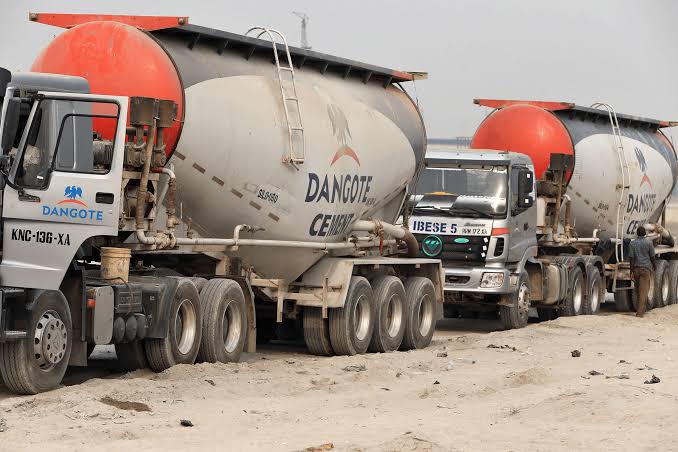
Nigeria's three largest cement manufacturers — Dangote Cement, Lafarge Africa and BUA Cement — reported a combined N5.8 trillion in revenue for the nine months ended September 30, 2026, a 21 per cent increase on the N4.8 trillion they recorded a year earlier, according to their unaudited accounts filed on the Nigerian Exchange.
Price, not volume, did most of the lifting. The revenue surge landed in a market where cement prices have risen steeply, and it translated into unusually strong profitability for the sector leader: Dangote Cement's profit after tax rose 31.2 per cent to N974.8 billion on revenue of N3.77 trillion, up 19.6 per cent, with earnings before interest, tax, depreciation and amortisation up 23.7 per cent to N1.77 trillion, Punch reported from the filings.
Dangote Cement's balance-sheet turn
The most consequential line in Dangote Cement's numbers may be the least discussed: the company swung to a net cash position. A cement business carrying expensive naira debt through Nigeria's high-rate cycle reporting positive net cash changes its capital-allocation story — dividends, capacity investment and regional expansion all become cheaper to fund, and finance costs stop eating into margins.
The operating leverage behind the numbers is real as well. Higher sales volumes, improved production and better cost discipline grew EBITDA faster than revenue, meaning each additional naira of cement sold arrived at a richer margin than the year before.
What N5.8 trillion says about the building economy
Aggregate sector revenue is a price story first, but it embeds a demand signal too. Cement is bought by builders, and nine-month revenues growing a fifth in a year imply that construction activity — government infrastructure, private residential projects and industrial builds — has continued to absorb product even at higher prices. Nigeria's construction demand has been supported by road and housing programmes and by the replacement demand that follows years of infrastructure underinvestment.
The distribution of that revenue is starkly concentrated. The three listed giants dominate formal capacity, and their combined N5.8 trillion dwarfs the earnings of most other listed industrial names; the sector's pricing power is the single largest reason the industrial goods index has been able to carry weight on the Nigerian Exchange.
The 21 per cent revenue growth also outpaced headline inflation, meaning the sector is not merely marking prices up with the index — it is gaining real revenue, whether through volume, mix or price increases in excess of input-cost growth. That distinction matters for how durable the earnings run proves to be.
The cost squeeze underneath
The margins come despite, not because of, the cost environment. Fuel and power costs across NGX industrial goods companies reached N820.7 billion in the nine-month period, up 6.3 per cent year on year, and cement kilns are among the most energy-hungry assets on the exchange. Each of the big three is investing in alternative energy — from waste heat recovery to gas-fired power — to blunt that exposure, but the capex competes with shareholder returns.
There is also the question of how long pricing power lasts. Cement inflation feeds directly into construction costs, and if public-sector budgets are fixed in naira, sustained price increases eventually suppress volume growth. The nine-month numbers show no evidence of that ceiling yet; the full-year results will show whether it is approaching.
Read-through for investors and builders
For equity investors, the results cement the sector's role as the market's cash engine and explain why industrial stocks have been central to the Nigerian Exchange's 59.9 per cent year-to-date return. The risk is concentration: index performance increasingly depends on a handful of cement and telecom balance sheets.
For builders and developers, the numbers confirm that input-cost inflation is structural, not transitory — budgeting on flat cement prices is no longer a defensible assumption. And for policymakers, the sector's profitability is a double-edged indicator: it demonstrates that large-scale Nigerian manufacturing can earn world-class margins, while underscoring how much of those margins come from pricing in a market with limited import competition.
Up next
Transcorp Power Earns N83.1bn Pre-Tax Profit and Rallies 23% in a Falling Market
The generator’s nine-month results carried a 31.2 per cent margin, and the stock gained 23.37 per cent in the week the exchange shed N3.52 trillion overall.
More in Corporate
See all
NAHCO Grows Nine-month Profit 19% to N16bn
NAHCO lifts nine-month profit after tax 19.2% to N16.04bn with Q3 revenue up 16.5% to N55.64bn as aviation handling and logistics demand expands.

Beta Glass Q3 Profit Signals Margin-Expansion Run
Beta Glass reports 11.7% revenue growth to N40.37bn for Q3 with gross profit up 21.3% to N15.18bn, confirming pricing power and cost pass-through in packaging.

Bayer Raises 2026 Profit Forecast as Agriculture and Health Demand Hold Firm
Bayer raised its full-year 2026 profit forecast, with shares up about 3.6%, as crop-science and healthcare demand prove resilient across markets.
About the author
Yaw Boateng
Corporate Reporter
Yaw Boateng writes for BusinessPress.


