
Houthi Strike Reaches Riyadh Financial District as Oil Bets Split Two Ways
A landmark tower with Aramco offices was damaged just as Brent fell toward $96 on Iran-talk hope, while physical Murban crude jumped 3 per cent above Brent.
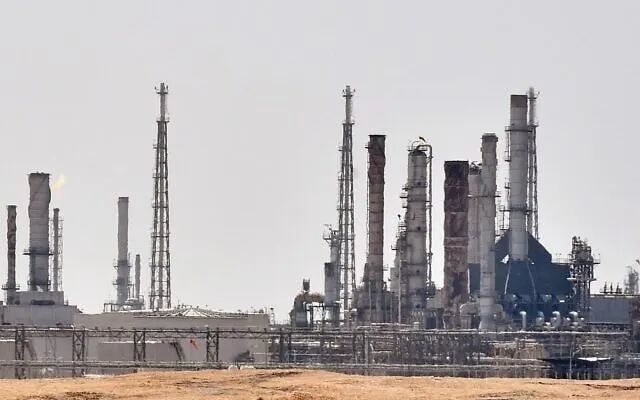
A Houthi strike damaged a landmark tower in Riyadh's King Abdullah Financial District on Sunday, with minor damage confirmed at Saudi Aramco offices inside the complex, according to regional reporting carried by Reuters-wire services — the first direct hit on the kingdom's financial heartland since the region's escalation cycle began, even as markets were pricing the very de-escalation that the strike's own timing tests.
Saudi state messaging downplayed the immediate impact, with officials indicating "the danger has passed" after the building — an icon of the kingdom's $500 billion giga-project capital programme — was struck. But the symbolic target list has now expanded beyond shipping and energy assets to the towers beneath which the sovereign's own financial infrastructure, the Gulf's private-wealth flows and the world's largest oil company's headquarters sit, and the market's risk pricing for the entire Gulf economic corridor will have to answer for it.
The target list that defines the risk regime
The strike's timing is the challenge for markets' already-completed de-escalation bets. Oil prices fell some 16-17 per cent last week — their worst weekly performance since 2020 — on the Trump administration's diplomatic signals, and Brent was holding between $96.59 and $98 a barrel in Monday's session as the news flow produced both directions at once: the President told CNN further strikes on Iran were "highly unlikely" if nuclear talks progress, even as Secretary of State Marco Rubio called Iran's own demands for blockade-lifting, sanctions relief and asset release before a Hormuz reopening simply unacceptable.
The physical market's pricing carries the same tension: Murban crude — the Gulf's physical benchmark — climbed more than 3 per cent to $99.17 on Monday, roughly $1.70 above Brent futures, evidence that cargoes for near-date delivery are still commanding a war-premium that the futures market has unwound. Two directional extremes — a softening benchmark and a strengthening physical differential — indicate the market is split between the Washington-channel's hope and the shipping-channel's risk, exactly the configuration in which one dramatic incident can reprice the week.
What the KAFD strike tells the Gulf's investors
King Abdullah Financial District's architecture is where the kingdom's post-2017 economic transformation plan parks its financial story: the PIF's infrastructure units, the regional headquarters programmes of foreign banks, the Gulf's growing financial-technology complex. A strike there is a structural event, not a military footnote. Insurance premiums for Gulf urban infrastructure, the sovereign-risk premium the kingdom's blossoming bond programme trades at, and the direction of real-estate and financial-services FDI pipelines — sectors into which hundreds of billions of dollars have been committed under Vision 2030 capital programmes — all get repriced when a mushroom-like column rises over the district's skyline.
The strike also tests the wider Gulf risk architecture's own assumptions. The world's largest oil company's decision apparatus operates from the same capital; and the market has historically treated the Aramco administrative layer as the region's most protected asset class. Minor damage notwithstanding, the fact of a successfully targeted strike on a landmark within its own perimeter tells every regional risk book that the air-defence perimeter — and the deterrence posture behind it — has a workable shadow.
Iraq's crude corridor and the Hormuz economics
The de-escalation signals running in parallel are substantial, and the Iraqi dimension is the newest: Baghdad's oil minister said over the weekend that Iraq has reached agreements with the United States to export crude through the Strait of Hormuz, adding the second-largest OPEC producer to the list of nations whose crude flow depends on the corridor rather than the alternatives. For world oil markets, the agreement folds the Gulf's Iranian-threat ledger into a testable diplomatic framework: the strait's reopening conditions remain Iranian demands for the lifting of the US naval blockade, sanctions relief and asset release, which Washington's own officials — in their public characterisation — refuse to consider.
The narrow strait handles about a fifth of the world's seaborne oil, and its "full reopening" scenario has been the market's war-premium gauge all autumn: when the risk of closure dominated, crude rallied; when the reopening came within range, the trade unwound the bet. Iraq's agreement to use the corridor signals that regional producer states are treating Hormuz as a normal commercial waterway again, and that the market's geopolitical forwards should be pricing corridor access nearer the commercial-baseline rather than the war-scenario.
The African and international read-through
For African markets the Gulf's risk regime is a directional price. Brent's crash last week was, for petrol-importing African economies (including Nigeria, Ghana, Kenya and Ethiopia), an instant import-bill relief at a moment their fiscal plans for 2027 had been framed against a $100-plus crude regime — and any renewed escalation rebuilds the risk premium in their fuel import bills. The differential leg cuts the other way: Nigeria's and the wider West African light crude basket earns its premiums in the same physical Gulf market whose differential just climbed 3 per cent, meaning a de-escalation that softens the physical complex also squeezes realized crude values per barrel.
For global financial markets, the KAFD event is a portfolio-scale reminder that the Gulf's transformation capital story — the infrastructure, the financial-services buildout, the sovereign wealth flows — has always been priced, historically, at a risk premium the market kept separate from the energy story: no longer. The capital flows into the kingdom's non-oil build have been the largest single emerging-market development commitment of the decade; pricing them now requires an integrated risk model in which the region's financial districts, its energy assets and its diplomatic trajectory share the same risk budget.
Up next
Egypt’s enza Raises $6m to Scale Bank-Payment Rails Across Africa
The 4DX-led round with BII, Quona and Algebra will push the payments-infrastructure platform into new markets and licence territories beyond its twelve-country base.
More in Business
See all
Nigerian Oil Companies’ Revenue Jumps 58.6% to N11.81trn — but Profits Barely Follow
Seven listed producers grew nine-month revenue sharply on strong crude prices, with acquisition charges and finance costs absorbing most of the gains before they reached the bottom line.

Dangote Refinery Petrol Exports Surpass Nigeria’s Daily Consumption
NMDPRA data show 54.63 million litres a day exported in September, up 37.3 per cent and above the 44.4 million litres of average domestic consumption.

Dangote Concedes Refinery IPO Missed the 10-Million-Investor Target
Orders of about N6.4 trillion lifted the raise to a near-triple oversubscription, but retail participation was capped by access and know-how, the chairman said.
About the author
Yaw Boateng
Corporate Reporter
Yaw Boateng writes for BusinessPress.


