
Dangote Eyes Egypt In Pan-African Industrial Push
Dangote Group is exploring industrial investments in Egypt as the conglomerate deepens its pan-African manufacturing footprint beyond a dozen countries.
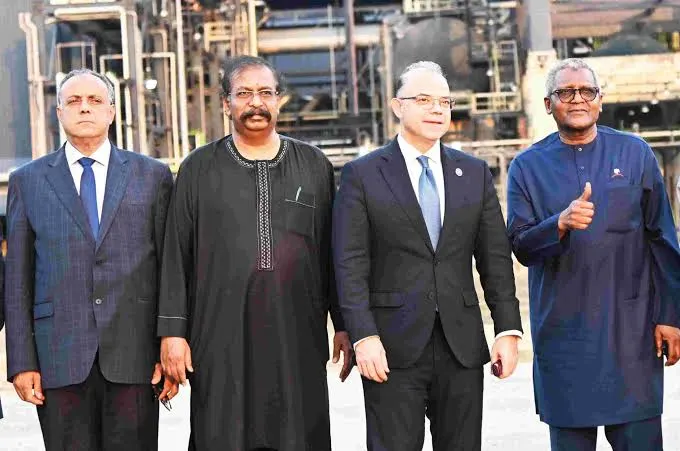
The Dangote Group is exploring the expansion of its industrial investments into Egypt, deepening a pan-African footprint strategy that already spans cement, fertilizer, refining and food processing across the continent — a move that would place Africa's largest industrial conglomerate in the Arab world's largest market at a moment when both oil-dependent Gulf capital and pan-African manufacturers are repositioning for the continent's next decade of growth.
The development, reported by City Business News on Tuesday, extends the conglomerate's investment philosophy under which its operations now span more than ten African countries, with Nigerian-built capacity designed repeatedly for neighbouring-market replication. Egypt's appeal is structural: a population exceeding 100 million, a manufacturing base with a decades-deep industrial culture, sub-Saharan freight corridors through the Suez zone and a government actively courting industrial investors as its currency adjustment programme makes local production more competitive against imports.
Why Egypt fits the Dangote industrial logic
The group's cross-border expansion playbook has a recognisable architecture: identify markets where demand structurally exceeds locally supplied capacity, build at a scale that sets the market's cost frontier, and integrate backward into raw materials — quarrying for cement, petrochemical feedstock for fertilizer, and in refining, an integrated supply chain that transformed Nigeria's petroleum products market. Egypt offers each of the ingredients. Its construction sector, driven by new cities, infrastructure corridors and population housing programmes, consumes cement at volumes that rank among Africa's largest, while its fertilizer and petrochemical inputs are among the continent's most competitively priced and abundant.
A move into Egypt would also carry symbolism for South-South industrial investment. Nigerian conglomerates — historically recipients of inbound industrial investment and foreign partnership structures — have built the reverse scenario: Lagos-headquartered capital deploying industrial capacity aboard under a brand that has become one of the most recognisable names in African business. Forging the pathway in North Africa, where Egyptian industrial groups themselves are major players, represents a different competitive register than the West and Central African expansions where Dangote's scale set benchmarks.
Where the industrial appetite fits into Nigeria's own agenda
The expansion conversation coincides with the group's Nigerian operations undergoing their own landmark repositioning. The Dangote Refinery's entrance into the petroleum products market has restructured domestic fuel supply economics, its fertilizer complex has converted Nigeria into a meaningful urea exporter, and its cement division — the continent's largest — has continued acquisition and greenfield programmes across Africa. Each operation has anchored the investment climate argument Nigerian authorities make to global investors: that Nigeria's private sector can build world-scale assets despite the macroeconomic adversity that has defined the past half-decade.
For the federal economic programme, successful Nigerian corporations expanding abroad function as signal and tax question in equal measure. Operations in Egypt generate industrially capable Nigerian management experience, foreign currency earnings from realized dividends, and status for Nigeria as an outward-investment origin; at the same time, fiscal authorities weigh where profit centres and employment taxation land when capital deploys across a continent where Nigeria's own development finance needs remain immense.
Timing and competition in the Egyptian industrial market
Egypt is not an easy market entry at this juncture. Local cement groups enjoy entrenched distribution, energy-cost relationships and regulatory familiarity; the devaluation of the Egyptian pound since 2022 has raised the landed cost of any dollar-denominated input while local-currency pricing compresses returns in dollar terms; and government procurement practices — especially in infrastructure-linked demand — reward incumbency. A new industrial entry, Dangote-style, would likely arrive either through greenfield facilities with distinctive technology economics or through shareholding in distressed local capacity offering consolidation synergies.
The group's entry would also interact with the region's broader investment currents. Gulf sovereign capital has increased its Egyptian industrial footprint substantially in recent years, Egyptian conglomerate groups are expanding within their home market under the same devaluation-competitive logic, and Turkish and Chinese industrial investors maintain active factories across Egyptian industrial zones. A Nigerian entrant would distinguish itself less on price than on integration: the only comparable African manufacturer that controls raw materials, logistics and end markets across multiple countries simultaneously.
Implications for the pan-African trade agenda
The exploration fits directly into the economic integration agenda the continent's policy institutions have marketed for a decade: African factories selling to African markets at industrial scale, with the AfCFTA's tariff architecture easing the trade costs that historically made intra-African industrial trade harder than trade with Asia or Europe. Dangote's cross-national cement freight flows — moving product between plants in Nigeria, Senegal, Ethiopia, Zambia and Tanzania — already function as a case study of what the continental trade map can look like when capital, product and management move across African borders.
An Egyptian extension of that map would connect West African and North African industrial economics, giving the AfCFTA's largest market integration chapters a corporate-scale demonstration. For Egyptian authorities courting the investment, the benefits are equally concrete: integrated raw material chains, Nigeria-proven operational systems and a flagship transfer of Nigerian manufacturing capital into a market that has spent two years rebalancing its investment promotion towards productive-sector economics.
No investment has been formally signed, and the group's exploration phase leaves open which sub-sector — cement, fertilizer, refining services or food processing — leads the entry. But the signalling value is already operative: the conglomerate that industrialised Nigeria's own market divisions sees North Africa as a territory in which its factory logic can compound, and that reading alone shifts how Egypt's footprint investors, competitors and policymakers will evaluate their own next moves.
Up next
CBN Purges 46 Microfinance Banks In Licence Sweep
The Central Bank of Nigeria revoked the licences of 46 microfinance banks in the sector biggest clean-up protecting depositors and4 disciplining the register.
More in Business
See all
Oando Holds Production Near 43,000 Barrels Daily
Oando produced 42,985 barrels of oil equivalent per day and grew nine-month revenue 9 percent, confirming its acquired Nigerian assets are operating at run-rate.

MTN Ghana Grows Service Revenue 33.5 Percent
MTN Ghana grew nine-month service revenue 33.5 percent to GHS23.2 billion with EBITDA up 40.6 percent and the margin reaching 61.5 percent as data and fintech drove growth.

Dangote and MRS Sign Fuel Supply Deal for Cameroon
Dangote Group and MRS Oil & Gas signed a fuel supply deal with Cameroon state refiner Sonara, extending Nigerian refinery exports across Central African markets.
About the author
Amaka Obi
Senior Business Reporter
Amaka Obi writes for BusinessPress.
More by Amaka Obi


