
Dangote and MRS Sign Fuel Supply Deal for Cameroon
Dangote Group and MRS Oil & Gas signed a fuel supply deal with Cameroon state refiner Sonara, extending Nigerian refinery exports across Central African markets.
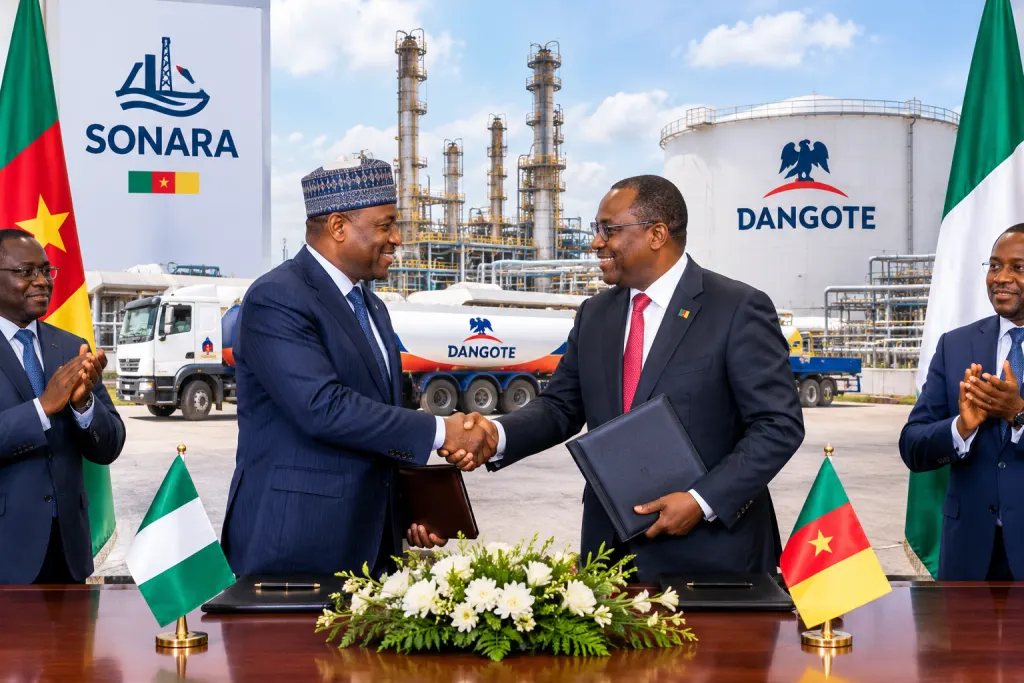
Dangote Group and MRS Oil & Gas signed a deal to supply refined fuel to Cameroon in partnership with the state refiner Sonara, which has imported all its refined products since an explosion shut the Limbe refinery in 2019, the companies announced last week — a commercial opening for Nigeria's largest refinery as it ramps output toward regional export markets.
The agreement positions Nigerian-produced gasoline and diesel at the centre of Cameroon's fuel supply chain ahead of, and independently of, Sonara's own restart. Volumes and pricing were not disclosed at signing, but the structure — Nigerian refining capacity, MRS's downstream logistics and a state-owned offtaker as distribution partner — creates a standing commercial channel from the Dangote refinery's loading arms to a Central African market of roughly 30 million consumers.
Africa's emerging refining map
Cameroon is the latest entry on a map being redrawn by African refining capacity. Since Nigeria's 650,000-barrel-per-day refinery started loading products in late 2024, the sub-region's fuel trade has shifted from a dependency on European cargoes toward intra-African supply, compressing the logistics premium packed into West and Central African pump prices. Algeria, Nigeria, Angola, Egypt — with new Gulf-standard capacity — and soon South Africa's damaged programme all shape a market in which the Dangote refinery is the largest single swing supplier.
For Cameroon, the deal offers a shorter, cheaper supply chain than the traditional route from European traders, and a chance to rebuild fuel security around a partner willing to invest in storage and distribution. For Nigeria, every secured offtake agreement converts refinery capacity into stable export revenue and supports the naira by displacing imports of petroleum products that Nigeria itself stopped needing.
The legal fights that come with expansion
Expansion is not without friction. In Kenya, the Public Private Partnerships Petition Committee dismissed a consumer group's challenge to Dangote's $16 billion Lamu refinery project after the Treasury argued it was structured as a private commercial investment rather than a state concession — though two further cases return to the committee on 12 and 24 November, keeping the project's license to operate contested even as construction planning proceeds.
The Lamu battle matters as a template. A refinery project of that scale requires not just capital but regulatory cover for land, port access, product pipeline rights and environmental permits — and Kenyan petitioners are testing whether private mega-investments can be challenged in PPP forums. The risk profile is a cost of doing business across African markets where regulation and litigation interact, and the outcome on 12 November will matter for how eagerly other investors price greenfield entry into East African energy.
What the deal means for fuel prices and trade
For Nigerian motorists, capacity exported means the home market's product balances lean on a plant whose costs fall with scale, and domestic pump-price competition between the Dangote refinery, the restructured NNPC retail network and independent marketers has already driven new pricing rounds this past week as the refinery announced fresh rates. Export contracts deepen that competitive picture by adding revenue that is not hostage to Nigerian demand cycles.
For Cameroon and the wider CEMAC zone, cheaper landed fuel offers a direct inflation prompt: transport costs, food distribution margins and electricity-producing feedstock prices all sit downstream of refined-product pricing. A Central African supply chain anchored to West African refining rather than European spot loading reduces exposure to the sea-lane shocks that pushed Brent crude near $105 a barrel before this week's partial retreat.
The competition's response is the other part of the map: Sahara Group's ongoing expansions, the restructured Port Harcourt refinery's restarts, and a string of modular refinery projects across the Niger Delta compete for the same regional offtake, meaning the Dangote-MRS-Sonara agreement is as much a first-mover move as a monopoly play. As regional refining matures, offtake contracts, storage rights and shipping relationships — rather than refining capacity alone — will decide who captures the margin between crude prices and pump prices across West and Central Africa.
For African trade integration advocates, the deal is proof of the AfCFTA's fuel thesis: Nigeria exports manufactured products to neighbours in the region, substituting formerly European-sourced supply and keeping the value addition inside the continent — a pattern that industrial policymakers in Abuja and Yaounde will both highlight, each for their own reasons, as the region's fuel supply chain turns inward.
Up next
Apple Beats Street but Guides Margins Lower
Apple beat quarterly estimates with record $114.48 billion revenue but shares fell as December-quarter margin guidance of 45-46 percent flagged rising memory costs and slower services growth.
More in Business
See all
Lagos Economic Roundtable to Shape 2027 Development Priorities
“The economic outlook for 2027 requires deliberate policy choices that will strengthen our resilience, sustain economic growth and...

Church & Dwight Grows Organic Sales, Offsets Weak Volumes
Church & Dwight posted third-quarter sales of $1.60 billion, up 1.0%, with organic growth of 5.1% and adjusted EPS of $0.92, up 13.6%.

Lear Posts Modest Third-Quarter Sales in Auto Lull
Auto-parts supplier Lear reported third-quarter revenue of $5.8 billion, up about 2%, against a soft global vehicle-production backdrop.
About the author
Amaka Obi
Senior Business Reporter
Amaka Obi writes for BusinessPress.
More by Amaka Obi


