
SpaceX in Talks Over Boost Mobile Wireless Entry
SpaceX shares rose more than 3 percent after a report it is in talks to buy Dish Network Boost Mobile or use its network, opening a path into the $235 billion US wireless market.
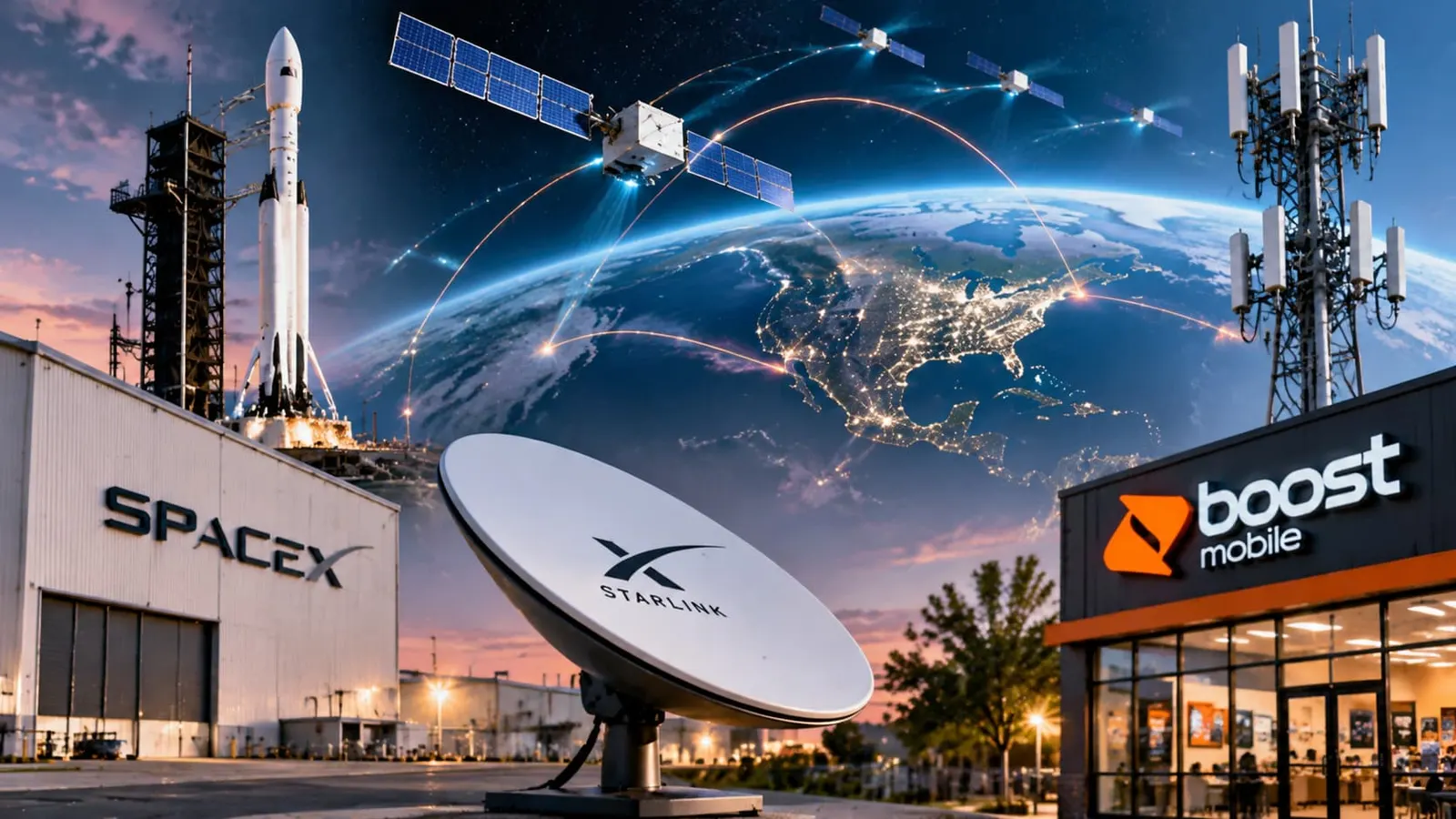
SpaceX shares rose more than 3 percent on Monday after a Washington Post report that the rocket and satellite company is in talks to buy Dish Network's Boost Mobile subsidiary or use its network — a step that would hand Elon Musk a path into the $235 billion US wireless market through the retail customer base that Dish assembled over fifteen years.
The strategic logic is capacity. SpaceX has been building Starlink's direct-to-cell capability — satellites that connect standard consumer phones — into a service it plans to commercialise through carrier partnerships rather than its own retail brand, and a Boost acquisition or network arrangement would give it immediate access to spectrum rights, retail distribution and a paying subscriber base without waiting for those partnerships to mature.
Why Boost is the entry point
Boost Mobile is the retail remnant of Dish's turn from broadcaster to network operator: millions of prepaid customers, an established brand in the value tier of the US market and — after Dish's merger-era spectrum accumulation — a set of network arrangements that survived the parent company's financial restructuring. A large prepaid base is precisely the asset a satellite-to-phone entrant wants first: users whose cost sensitivity matches satellite messaging's early value proposition of coverage, affordability and reach in network-blind spots.
Buying the operator outright would be the fastest route, but the network-use structure reported alongside it — leasing access rights rather than acquiring the whole business — would be the asset-light version: SpaceX gets the customers and channels, and the spectrum is conserved for its original holders. Both paths point the same strategic direction, which is why investors treated the report as more than deal speculation.
Starlink's direct-to-cell push
The move follows an established build. SpaceX has launched successive generations of Starlink satellites with direct-to-cell payloads, announced carrier trials in multiple countries, and framed coverage-then-capacity as the commercial sequence: emergency messaging first, then texting, and progressively data services as the satellite constellation grows dense enough to carry traffic. The approach turns dead zones — the roughly one-fifth coverage gap in a country of dense networks — into SpaceX's beachhead market.
A US wireless entry changes the competitive frame at home. American carriers have partnered with satellite rivals or built in-house direct-to-cell capabilities, and an operator that owns its own satellite constellation, launch capacity and customer channels can undercut the partnership model on cost — the same vertical integration logic that made Starlink a structural force in consumer broadband markets on several continents.
The $235 billion question
The US wireless market's scale — $235 billion in annual revenue — is the prize that makes a Boost-sized deal strategically rational. Satellite-to-phone is not going to win iPhone upgrade cycles in its first phase; the beachhead is coverage, rural markets, emergency services and IoT fleets. But every percentage point of a market that size is worth billions, and vertically integrated entry — constellation, launch, retail — is the strategy Musk's companies have executed profitably in other infrastructure-verticals before.
The execution risks are the usual platform economics: Dish's prepaid subscriber base is valuable only with a workable network pathway; spectrum regulation in the United States remains a contested, politically freighted arena; and satellite capacity costs before full constellation density can damp margins even as revenue rises. Confidence also has to survive the capital intensity — SpaceX has been funding Starlink expansion from founder-led capital events rather than traditional fundraising, and a wireless entry adds retail marketing costs that satellite operations never carried.
For African and emerging-market telecom watchers, there is a broader implication: a SpaceX direct-to-cell retail entry in the deepest telecom market in the world sets the template for how satellite operators scale in markets where terrestrial coverage gaps are even larger — Africa's rural coverage economics shift meaningfully if satellite-linked service can bypass expensive tower buildouts — and every partnership Elon Musk negotiates with a carrier becomes a precedent for the next market entry.
Up next
UBS Upgrade Sends Rivian Shares Up 10 Percent
Rivian climbed 10 percent after UBS upgraded the EV maker to buy, arguing the sell-off overdone ahead of a sales inflection for the R2 midsize SUV.
More in Technology
See all
Reddit Revenue Surges as Advertising Demand Expands
Reddit reports faster revenue growth than audience growth, with stronger advertising sales and higher quarterly profit.

eTranzact Profit Falls as Operating Costs Increase
eTranzact reports lower nine-month earnings despite higher revenue, with administrative costs weighing on operating profit.

Serval Raises Fresh Capital for Enterprise Automation
Serval announces a $150 million funding round led by Sequoia as it expands workplace automation and implementation services.
About the author
Chinedu Nwosu
Technology Editor
Chinedu Nwosu writes for BusinessPress.
More by Chinedu Nwosu


