
Four Nigerian-Americans Win US Midterm Elections As Diaspora Clout Grows
Will Jawando, Junior Ezeonu, Oye Owolewa and Carol Kazeem won offices in the US midterms while Georgia's Segun Adeyina still leads his race, extending Nigerian diaspora political power.
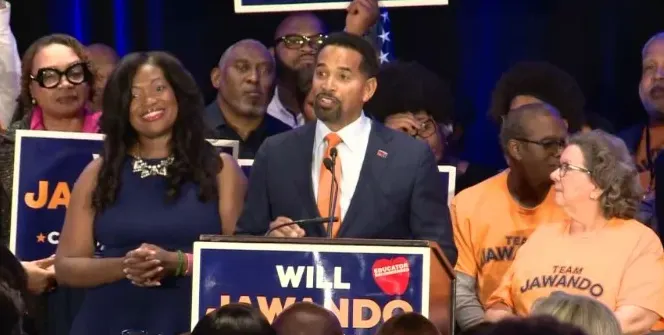
Four Nigerian-Americans won elected offices across the United States in Tuesday's midterm elections, with a fifth — Georgia state legislator Segun Adeyina — leading in a race still being counted, a haul that cements the diaspora of 378,000 Nigerian-born Americans as one of the most politically organised communities in the world and an increasingly relevant lobbying base for Nigeria's own economic interests in Washington.
The confirmed winners are Will Jawando, who defeated Republican Esther Wells in the Montgomery County executive race in Maryland with 237,383 votes — 78.15 percent of ballots cast on a 72 percent count, according to NBC Washington; 27-year-old Junior Ezeonu, who won the Texas House of Representatives District 101 seat after unseating incumbent Chris Turner in the Democratic primary and running unopposed in the general election; Oye Owolewa, who secured an at-large seat on the Council of the District of Columbia with 69 percent of the vote against independent Elissa Silverman's 21 percent; and Carol Kazeem, who retained her Pennsylvania House of Representatives District 159 seat against Republican Michael Bannon. All captured offices under the Democratic banner.
From local offices to national influence
The pattern matters economically, and the detail is sharper than a headline. Jawando, the son of a Nigerian father and an American mother, now runs one of America's wealthiest counties — a jurisdiction whose procurement, permitting and budget decisions move hundreds of millions of dollars annually and whose political networks feed into national politics. Ezeonu's biography, as detailed in campaign materials, traces back to Onitsha, Anambra State before a Texas childhood at age two and an eventual seat on the Grand Prairie City Council in 2021 that made him one of the city's youngest mayor pro tems. Owolewa, the son of Nigerian immigrants from Kwara and Osun states, is a pharmacist whose previous post as the district's elected shadow representative made him a high-visibility advocate for DC statehood. Kazeem was part of the group of eight Nigerian-Americans who won legislative seats in the 2022 midterms, making her re-election a consolidation rather than a breakthrough.
Adeyina, first elected in 2022 to the Georgia House, was still leading Republican Charles Lollar as Atlanta Journal-Constitution trackers showed him ahead with 1,353 votes to 689 — though only 8 percent of the estimated vote had been counted. Nigeria Info FM and Leadership reported a sixth Nigerian descendant, Gabe Okoye, had retained his Georgia House District 102 seat without opposition.
The economics behind the politics
The milestone intersects with a measurable economic story this publication has tracked for several years: Nigerian-Americans are among the most educationally advanced and highest-earning immigrant groups in the United States, with professional and entrepreneurial concentrations in healthcare, law, technology and financial services. Their transnational footprint is also direct at an individual level — remittances into Nigeria exceed tens of billions of dollars cumulatively over recent years, forming one of the largest single flows into the Nigerian balance of payments, and diaspora networks have quietly funded everything from veterinary clinics in the North to private universities in the South-West.
Politically, the growing roster of elected Nigerian-origin officials creates a distinct advantage that transcends party dynamics. A sitting member of a Maryland county council, a Texas state legislator, a DC council member and a Pennsylvania state representative belong to policy networks — county commissioners' associations, the Council of State Governments, state legislative lobbies — that are pathways into the broader American policy conversation. Officials from that set can raise issues tied to Nigeria in congressional committees, US Africa trade engagement, AGOA reviews and development finance matters that otherwise reach congressional attention only through large corporate lobby efforts.
The Democratic sweep that delivered congressional majorities to the party on Tuesday night likely increases the visibility of diasporic legislators in shaping that agenda — a party that now holds both chambers will be choosing committee chairmanships from its own ranks, while state and local winners like this week's Nigerian-American cohort build the seniority ladders that lead there. Their policy influence in the near term is still heavily local and state-side, where the vote share delivered this week is far more consequential.
Nigeria's stake in the diaspora's ascent
For Abuja, the political achievement raises questions that go far beyond celebration. A high-visibility diaspora with genuine legislative power can be leveraged on issues the Nigerian government has historically pursued though bilateral channels only — trade-preference reviews, investment treaty relationships, debt-relief initiatives, and the consumer fraud and money-transfer channels that affect hundreds of thousands of Nigerian households. That influence, however, depends on continuous relationship-building and a domestic economic story worth promoting. The Nigerian government has historically celebrated diaspora victories in occasions of symbolism, but the tougher ask — converting recognitions into trade delegations, investment seminar invitations and economic partnership frameworks — depends on a coherent domestic reform narrative that has moved from currency reform to industrial output.
There is also a domestic policy echo. Nigeria's 2027 election season is already characterised by debates on diaspora voting rights, which would connect more than 15 million Nigerian citizens living abroad to the domestic political process. With Nigerian-origin candidates now winning office in their adopted countries, the argument that Nigerian citizenship can mature into diaspora voting rights gains a stronger evidence base: if the diaspora columns of the political world can mobilise electoral support for candidates in Anambra, Kwara and Osun, the argument that other global capitals already trust their diaspora populations with a vote has, as of Wednesday, a fresh and measurable example.
The deeper test of this week's results will be whether a handful of state-level victories can be recycled into the sustained economic diplomacy that Nigeria's political class so frequently narrates — an objective explored in 2026's most ambitious diaspora policy debates — or whether the excitement of Wednesday will simply satiate a domestic audience hungry for diaspora achievements without producing the bilateral relationships that make them count. The persistence of that debate, and the near-certain addition of Adeyina's Georgia seat once counting concludes in the coming days, will preserve a window for Nigeria to make the most of a period in which its most successful diaspora is now, in effect, part of the American political establishment.
Up next
US Moves To Terminate South Africa And Rwanda From AGOA From January 2027
President Trump notified Congress of intent to end duty-free AGOA access for South Africa and Rwanda from January 1, 2027, in a warning for all African exporters.
More in Business
See all
Nigeria Startups Raise 635m As Access Drive Begins
Nigerian startups raised 635 million dollars in nine months as Magna Collective organised an investor connection drive pairing 26 founders with 16 funds.

Aradel Output Rises Sevenfold to 144,700 Barrels
Aradel Holdings grew nine-month revenue 633 percent to N3.95 trillion and averaged 144,700 boepd, up from 24,000 boepd, after consolidating newly acquired subsidiaries.

Oando Holds Production Near 43,000 Barrels Daily
Oando produced 42,985 barrels of oil equivalent per day and grew nine-month revenue 9 percent, confirming its acquired Nigerian assets are operating at run-rate.
About the author
Amaka Obi
Senior Business Reporter
Amaka Obi writes for BusinessPress.
More by Amaka Obi


