Abbey Bank profit rises 56% as deposits expand faster than lending
Net interest earnings more than doubled, but reported earnings per share fell against a much larger capital base.
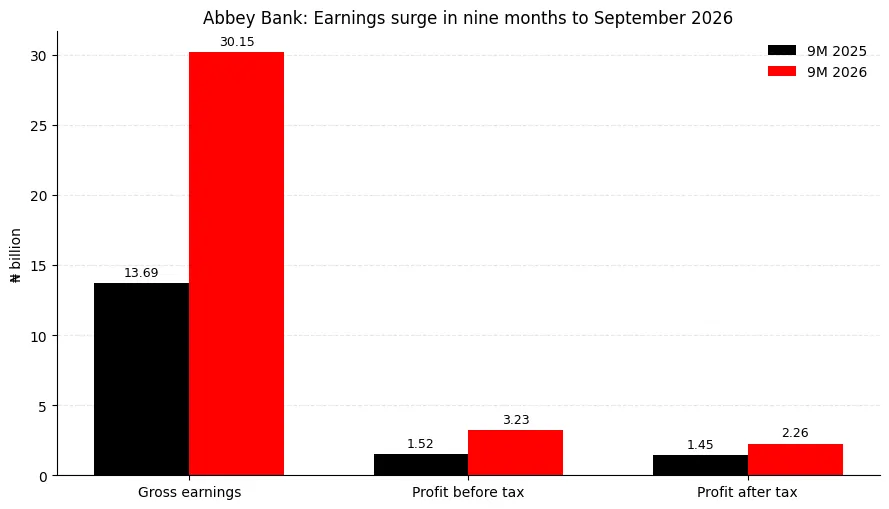
Abbey Bank increased nine-month profit after tax by 55.9% to N2.26 billion, while a much larger equity base left reported earnings per share below the prior-year level. Its unaudited accounts, disclosed through the Nigerian Exchange on 28 October, also show deposits expanding much faster than customer lending.
The result is a balance-sheet transformation as well as an earnings announcement. For shareholders, the central question is how effectively the larger pool of funding and capital can be employed, rather than whether the increase in total profit alone demonstrates a stronger return on ownership.
Interest earnings more than double
Abbey's nine-month statement reports interest income of N28.83 billion, against N13.09 billion, and net interest income of N6.56 billion, against N3.10 billion.
BusinessPress calculations put the growth in net interest income at about 112%. The increase demonstrates that a larger amount remained after interest expense, but it is not the same as a net interest margin. That margin would require an appropriate average earning-asset measure.
The distinction matters when a balance sheet is expanding quickly. Income can rise because more assets are deployed even if the return earned on each unit changes little. Investors need to separate the benefit from scale from the efficiency with which funding is converted into earnings.
Tax narrows the gain reaching the bottom line
Pretax profit increased to N3.23 billion from N1.52 billion. The income-tax expense rose to N969.29 million from N68.43 million, leaving net profit at N2.26 billion against N1.45 billion.
The figures imply pretax growth of approximately 113%, about twice the rate of growth in net profit. They also imply a tax charge near 30% of pretax profit, compared with roughly 4.5% in the corresponding period.
Those effective percentages describe reported accounting outcomes, rather than identifying a single change in tax law. They explain why a strong improvement before tax cannot be carried directly into a forecast of what shareholders retain after tax.
The deposit increase does not become an equivalent loan expansion
Customer deposits reached N263.81 billion, against N79.63 billion at December 2025. Loans and advances were N11.08 billion, compared with N9.72 billion.
BusinessPress calculations put customer loans at about 4.2% of the disclosed deposit total at September. This is a simple ratio between two balance-sheet lines, not a regulatory loan-to-deposit calculation.
It shows why the funding increase should not be described as an equivalent increase in credit supplied to households and businesses. Funds can be held in bank placements and securities as well as customer loans. Each category has different liquidity, return and risk characteristics, so the choice of deployment matters for the bank's future earnings.
Capital expansion changes the shareholder comparison
Total equity increased to N73.76 billion from N10.79 billion at year-end. Reported nine-month basic earnings per share were 8.22 kobo, compared with 19.06 kobo.
The per-share decline of about 56.9% sits alongside higher aggregate profit. That combination demonstrates why headline earnings and earnings attributable to each share are not interchangeable.
A larger capital base can support expansion and absorb risks, while also changing the denominator used to measure returns. Investors should assess how quickly the business can earn sustainable income on the resources added. A simple annualisation of interim profit would overlook the timing of capital deployment and changes in the balance sheet during the period.
The latest accounts do not establish the outcome of a new strategy
The figures cover the period ended September. They should not be used to claim that activity planned after that date has already produced earnings. The disclosure is distinct from earlier coverage of the bank's commercial-banking transition.
For customers, stronger reported funding does not by itself establish new lending terms or access to a particular product. For shareholders, the next meaningful assessment is whether the expanded resources generate stronger comparable returns while credit and liquidity risks remain controlled.
The present result establishes higher net profit, wider net interest earnings and a much larger funding base. Its limits are equally clear: the growth in deposits has not appeared as a matching increase in customer loans, and the reported per-share earnings comparison remains weaker.
Up next
MeCure profit rises 36% as marketing savings lift operating margin
Operating profit grew faster than revenue, but finance costs absorbed about half of that result as the company expanded its fixed assets.
More in Finance
See all
NEM profit rises 31% as operating cash flow turns negative
Higher underwriting and investment results lifted nine-month earnings, but claims payments and weaker premium receipts weighed on operating cash.

Infinity Trust loan growth draws on borrowings as funding costs increase
Customer loans rose to N36.69 billion as borrowing grew faster than deposits. Inconsistencies in the filing require clarification.
Standard Chartered confirms Adelagun as Nigeria CEO amid foreign-bank reset
The local appointment signals continuity at a key trade-finance bank as foreign lenders reassess risk, capital and growth in Nigeria.
About the author
Musa Abdullahi
Finance Correspondent
Musa Abdullahi writes for BusinessPress.