
Nigeria Reserves Growth Slows to $295m in October
External reserves rise just $295m in October to $55.22bn — the smallest monthly build this year — as oil shortfalls and debt service absorb the year accretion.
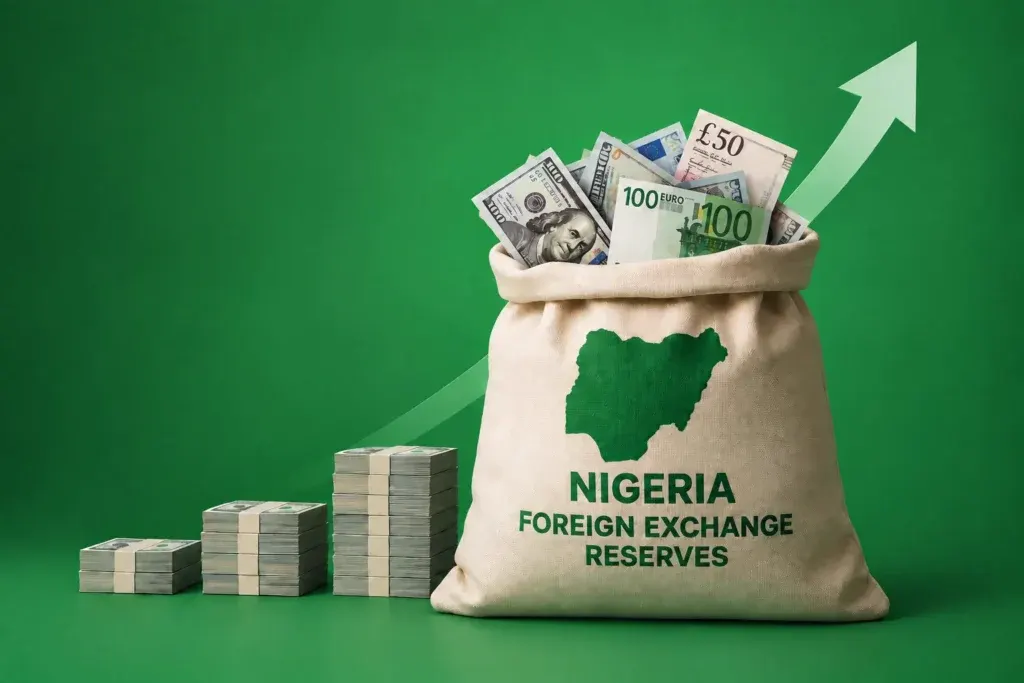
Nigeria's external reserves grew by just $295 million in October to $55.22 billion — the smallest monthly build this year — according to central bank data released in the government's November 6 economic bulletin, a slowdown that ends the year's double-digit monthly accretion rhythm and marks the transition of reserve policy from accumulation mode to maintenance mode.
Context frames the significance. Reserves have risen $9.66 billion since January, a build that anchored the naira's re-stabilisation, funded the CBN's credibility in unifying the FX market, and underwrote the risky decision to cut the Monetary Policy Rate by 350 basis points in September while the currency sat near N1,349. October's near-flat reading therefore does not jeopardise the year's achievement — but it reveals the limits of the accretion model exactly when the fourth quarter's FX demands arrive.
The arithmetic of a stalled build
Reserve growth equals inflows minus outflows, and October's near-zero net tells a two-sided story. On the inflow side, Nigeria entered the month with softer oil receipts against the production shortfall — August output at 1.678 million barrels per day against the budget's 1.84 million assumption — and oil prices, though near $104 at their recent peak, had begun the quarter's ceasefire-driven retreat. On the outflow side, the CBN's own interventions, FX utilisation running at record levels ($18.3 billion in Q2), and debt-service outflows against a government whose debt service consumed N7.7 trillion in the first half, all drain reserve accounts.
The slowdown also reflects seasonal mechanics: October sits just before the year-end import surge, when fuel, food and industrial FX demand peaks, and central banks often deliberately allow reserves to flatten ahead of the season to preserve intervention capacity. A flat October may be prudent conservation rather than lost accretion — but it signals the margin in which the CBN can absorb December's dollar draw has compressed to its thinnest level this year.
Reserves as the exchange-rate anchor
The level remains genuinely comfortable by Nigerian standards. At $55.22 billion, reserves cover roughly eight months of import demand — a buffer that has more than restored the credibility lost in the 2020-2023 era, when cover fell to critically low levels and the market rationed accordingly. That buffer is the reason the naira has held near N1,349 officially through a week of global dollar strength; the market prices intervention capacity, and $55 billion buys a different kind of stability than the $33 billion the country held in late 2023.
The composition caveat gives pause to the headline. A portion of reserve accretion in 2026 has come from borrowed inflows — most concretely, the government's external borrowing programme, which includes a fresh $7.7 billion request with CBN designated to receive proceeds. Reserves financed by borrowing are fungible buffers, not free assets, which is why the quality of the October build matters as much as its size: accretion from trade surpluses and remittances can be held indefinitely, while borrowed reserves create future outflows.
What the fourth quarter needs
Three flows will determine whether December ends the year with reserves still above $55 billion. Oil receipts are the largest variable: the production shortfall's revenue cost runs into billions of naira monthly, and the ceasefire-discount risk documented this week — Brent's largest weekly drop since 2020 on de-escalation bets — could shave dollar inflows further if crude settles below $100. Non-oil inflows — remittances, exports, portfolio flows — have carried the year's build and their Q4 performance, against the global risk-off backdrop of the AI rout, is the second leg. Third is the government's own external borrowing: if the $7.7 billion programme draws down before year-end, the reserve account receives a one-time cushion that changes the optics even as it adds to liability.
For the naira, the stakes are asymmetric. The reserve buffer's credibility does most of the stabilisation work — the market prices the ability to intervene, not the need to. A reserves level holding steady through the fourth quarter sustains that perception; a decline of $3-4 billion would restart the degree-of-cover conversation that inflated Nigerian risk premia in the past decade, raising funding costs exactly as the DMO's November retail offers and bond issuance must clear.
What it means for the 2027 plan
The stalled build lands on a 2027 budget arithmetic already stretched. Government debt stood at N166.79 trillion in June, debt service is earmarked at N15.81 trillion for 2026 — about 45 per cent of projected revenue — and the fiscal authorities' preference for Eurobond issuance depends partly on the credibility an external-reserve position confers. A reserves plateau forces the CBN to defend stability with policy and market microstructure rather than with deep intervention pockets, sustaining the pressure for the fiscal discipline its own researchers published this week.
For investors across Nigerian assets, October's $295 million is the report card's most honest line: it shows the reform-era recovery has banked its year-to-date gains and now transitions to defending them. If November-December flows — oil volumes, non-oil inflows, and the borrowing programme — can hold the line through the import season, 2026 ends as the year Nigeria's external position was rebuilt. If they cannot, the fourth quarter will price the difference, and it will be the exchange rate and the bond market that do the pricing.
Up next
Nigeria Bond Yields Rise Despite 57% Cash Jump
Bank cash jumped 57% to N7.373tn in October yet average bond yields climbed to 16.18%, as investors hold duration ahead of a N10.85trn maturity wall.
More in Economy
See all
Banks Raise Prime Lending Rates In Eight Sectors Despite CBN Cuts
Nigerian banks raised average prime lending rates in eight key sectors including agriculture, construction and manufacturing despite successive cuts to the central bank policy rate.

Remittance Gains Offset By Rising Payments To Investors
Nigeria recorded higher diaspora remittances in Q2 2026 even as payments on foreign investments rose, leaving the external income balance thinner.

Nigeria Money Supply Approaches The 100tn Mark
Nigeria broad money supply has climbed to N99.23 trillion despite CBN tightening, reviving inflation and naira concerns ahead of the December MPC.
About the author
Abiodun Abdullahi
Author / Business and Markets Writer
Abiodun Abdullahi writes for BusinessPress.
More by Abiodun Abdullahi


