FAAC Shares N2.428 Trillion September Revenue Among Three Tiers of Government
The Federation Account Allocation Committee distributed N2.428 trillion to the Federal Government, states and local councils from N3.913 trillion gross revenue for September 2026, with Value Added Tax emerging as the states' single largest allocation source.
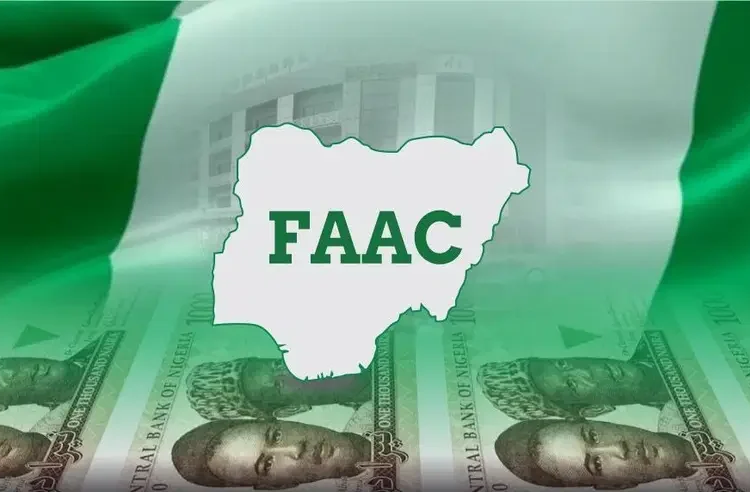
The Federation Account Allocation Committee has distributed N2.428 trillion to Nigeria's three tiers of government as allocation for September 2026, drawn from gross federation revenue of N3.913 trillion, the Office of the Accountant-General of the Federation said on Thursday.
The distributable sum is N90 billion higher than the N2.338 trillion shared the previous month, a modest improvement in a revenue environment still shaped by exchange-rate and oil-production volatility.
How the N2.428 trillion was split
From the distributable total, the Federal Government received N832.242 billion, the 36 state governments received N799.872 billion, the 774 local government councils received N560.660 billion, and N236.049 billion went to oil-producing states as 13% derivation revenue.
The total comprised N1.672 trillion in statutory revenue and N756.587 billion in distributable Value Added Tax. Within the statutory pool, the Federal Government took N756.583 billion, states N383.749 billion and local councils N295.855 billion, with the balance to derivation.
VAT is where the states live
The VAT distribution reveals the fiscal reality facing state governments. Of the N756.587 billion in VAT, states received N416.123 billion, compared with just N75.659 billion for the Federal Government and N264.805 billion for local councils. In other words, states collect more from VAT than from the statutory account itself in this cycle.
This is why the ongoing national debate over VAT derivation and the sharing formula is so consequential for state governors. As tax reform deepens and consumption taxes grow, control over the VAT pool and the basis on which it is distributed becomes a first-order question of state finances. For many states, the monthly FAAC cheque and their VAT share are the difference between meeting payroll and falling behind.
What it means for public spending
Higher allocations should, in principle, translate into more room for states to fund infrastructure, health and education. But a one-month rise of N90 billion across 36 states and the federal government is marginal once spread across competing obligations, including salaries, pensions and the growing cost of servicing subnational debt.
The structural weakness remains the narrow revenue base. With oil still a large share of federation receipts and non-oil revenue only gradually expanding, the monthly allocation will continue to swing with crude prices, production and the exchange rate. That volatility makes multi-year budgeting difficult for states that rely heavily on transfers.
What to watch
Watch whether the improvements in revenue reported through 2026 are sustained into the fourth quarter, when lower oil prices could feed through with a lag. Also watch how states apply the higher VAT receipts: whether the money is directed towards capital projects that raise future revenue or absorbed into recurrent spending that leaves them dependent on the next monthly transfer.
Up next
Dangote Cement Adds Goldman Sachs and UBS for $1 Billion London Listing
Africa's largest cement producer has appointed Goldman Sachs and UBS as bookrunners for a London secondary listing that could raise about $1 billion as early as November, with investor meetings due to begin on October 27 in London, South Africa and Dubai.
More in Economy
See all
IMF Urges Nigeria to Raise Non-Oil Revenue and Warns Against Blanket Petrol Subsidy
At its annual meetings, the International Monetary Fund urged Nigeria to broaden its revenue base beyond oil and redirect subsidy savings to vulnerable households, warning that blanket energy subsidies are expensive, regressive and unsustainable.
Nigeria Inflation Slows to 14.63% in September, a Fourth Straight Decline
Headline inflation eased to 14.63% in September 2026 from 15.39% in August as food prices retreated, but the National Bureau of Statistics reported that core and urban price pressures picked up, complicating the outlook for further rate cuts.
Nigeria spent N5.28tn on domestic debt service in H1 2026
Nigeria spent N5.28 trillion servicing domestic debt in the first half of 2026, with interest and rental payments accounting for N4.95 trillion, according to the Debt Management Office.
About the author
Tunde Balogun
Economics Correspondent
Tunde Balogun writes for BusinessPress.
More by Tunde Balogun