
Gold Reclaims $4,100 as Central-Bank Buying Offsets a Hawkish Fed Path
Spot gold rallied 1.4 per cent to about $4,123 even with December hike odds near 76 per cent, as Q3 central-bank purchases of 321 tonnes anchor the floor.
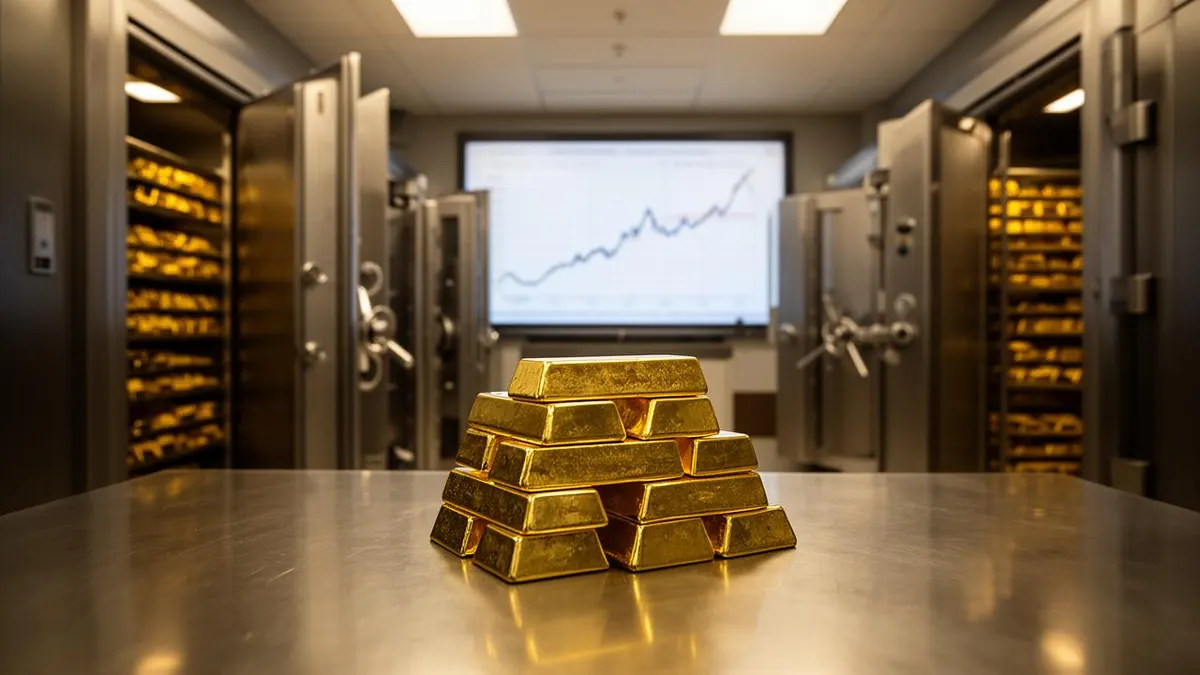
Gold clawed back above the $4,100-an-ounce line in Monday trading, rallying 1.4 per cent to about $4,123 as the metal regained the insurance bid it surrendered at the end of last week — but the metal's rise is being priced into a market that now assigns December's Federal Reserve meeting a roughly 76 per cent probability of a hike, an unusual combination in which gold strengthens as the rate-hike odds harden.
The commodity's drivers have traded places twice in a week. Friday's blowout US jobs report lifted the dollar and pulled gold down as much as $66 an ounce intraday as traders marked down expectations for rapid Fed easing; Monday's trade saw the dollar index ease 0.1 per cent to 102.22 and oil soften, with the metal bouncing back to $4,123.46 spot and $4,132.70 for the December Comex contract — showing that its underlying bid (central-bank reserve shuffling, Asia-side demand and AI-trade hedging) remains intact even as the rate path hardens against it.
The pattern of the metal's insolvency and resilience
Gold's Monday morning trade confirms the thesis the last three sessions set up: it is a metal that reveals pressure points as they move in and out of play rather than one that trades on one macro axis. Friday's trade put the metal's strength back on central-bank demand and the geopolitical bid, with the yellow metal trading down 0.4 per cent on a strong dollar day but recovering before the close on safe-haven flows as the AI-equity rout took a breath. Monday's design is that the AI-trade's escalating volatility — the last fortnight has seen a $3 trillion swing in US technology-stock market capitalisation — has built a persistent institutional bid for any asset uncorrelated to the tech ledger, and gold is the historic vehicle of that allocation.
The underlying bid remains historic. The World Gold Council's third-quarter data, published in the past week, shows central banks purchased 321 tonnes in Q3 — the fastest buying pace since 2024 — led by emerging-market reserve managers who have continued the post-2022 pattern of reducing Western exchange-frozen assets and increasing gold credit against their sovereign balance sheets. In Africa this pattern has visible expression: Nigeria's reserve basket allocations to bullion have been increased repeatedly over the last two years, and Ghana's gold-trading subsidiary programme has published record volumes this autumn.
Why a hawkish Fed and rising gold can coexist
The logic is counterintuitive but the components are resolvable. Gold's opportunity cost rises with real rates and dollar strength — the standard headwind that Friday's jobs print, and the resulting December-hike repricing, has delivered. But gold's insurance demand rises with the volatility of the assets it is hedging, and the AI-trade's current drawdowns — and the equity credit-cycle strains that followed — offer precisely that. The resulting balance is the one we are watching through the last nine sessions: gold holding a tight floor above $4,000 an ounce as long as both forces remain in play, and the metal's daily direction determined by whichever force is in the hotter seat that day.
The Fed decision that hangs over this market is binary enough that the metal's near-term ceiling and floor both compress around it. A December hike — the market's 76 per cent case — raises real rates and the dollar floor, and historically chips a few per cent from gold's bid for a fortnight; a surprise hold or dovish 360-degree pivot instead unleashes the metal's insurance bid against the slowing-growth trade, and the probability weight of $4,200-before-Christmas flips on a single FOMC session.
What the metal is saying to Africa
For Africa's mining economies the $4,000-plus regime is as material as ever. Ghana, Tanzania, Mali, Burkina Faso, South Africa and Zimbabwe derive fiscal and export receipts directly from the world price, and the last two years' record prices have enabled fiscal transformation in mining-heavy states: Ghana's small-scale licence programme, planned new industrial mining projects and the West's new critical-minerals frameworks have all been sized off a gold price that has not yet featured a sustained sub-$4,000 drawdown through the AI-era volatility. At $4,123 the metal still holds 6-month-realised returns in positive territory for African miners — the sector's most resilient quarter against a general mining basket that carries energy metals and copper as well.
For Nigeria specifically the commodity's message is twofold: the metal's strength supports the CBN's gold-purchase programme as a reserve-diversification instrument, while the same strength unlocks non-oil foreign-exchange through artisanal and licensed mining channels that the bank has formalised over the last year. Where gold's volatility throws uncertainty into the FX basket's near-term forecast, the metal's price floor remains a major stabiliser for Nigeria's non-oil reserve accumulation.
The path through FOMC week
Two immediate decision points price the metal's direction. Tuesday's US CPI — printed without a year-on-year headline because of the shutdown's data gap, monthly consensus at 0.3 per cent — is the Fed's last read before December; and the AI-earnings cluster (CoreWeave, SoftBank, Applied Materials through the week) that determines whether the equity volatility premium persists. If both came in as markets expect — a hike-validating inflation print and stabilising AI earnings — gold's path likely settles into a consolidation band against the dollar, with central-bank demand providing the floor.
Meanwhile the metal's longer structural story runs to the $4,203 April-2026 peak, which remains the record high; and the direction of travel through Central-Bank-purchase rates, AI-portfolio hedging and global currency-basket repositioning has not fundamentally changed since the metal became the world's most consequential non-fiat reserve asset in the 2025-2026 cycle.
Up next
SoftBank, CoreWeave and Applied Materials Deliver the AI Trade’s Credibility Test
The week’s earnings calendar answers whether AI’s capex plan survives contact with revenue: SoftBank’s portfolio marks, CoreWeave’s contracted demand and chip-equipment bookings.
More in Markets
See all
Gold Caught Between War Premium And Stubborn Rates
Gold consolidates near 3,950 dollars as US-Iran escalation risks clash with stubborn interest rates punishing non-yielding assets.
African central banks lift gold reserves 113% in shift away from dollar
African gold reserves rose 113% as central banks diversified away from dollar assets, strengthening resilience but raising valuation and liquidity questions.
NewGold Holdings Fall 13.3% as Units Trade at 57% Premium to Their Gold
Bullion backing Africa largest gold exchange-traded fund fell to $2.53 billion in the six months to September, yet the units closed at N86,001 in Lagos, roughly 57 per cent above the metal each unit represents.
About the author
Adaeze Okonkwo
Markets Editor
Adaeze Okonkwo writes for BusinessPress.


