
Teleperformance 15% Collapse Shows Europe Taking the AI Hit in Services
The Stoxx Europe 600 closed about 1 per cent lower on Friday as Teleperformance cut its outlook and insurers eased, completing a week of broad de-risking.
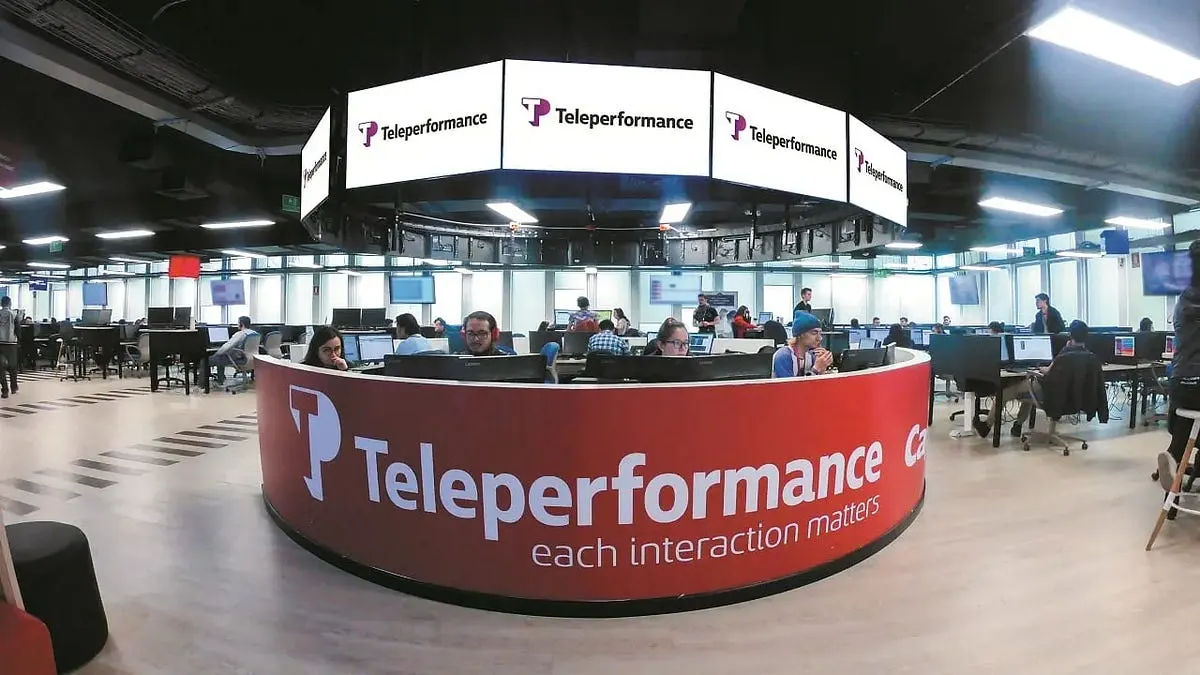
European shares closed their Friday session down about 1 per cent, with the Stoxx Europe 600 settling at 648.33 after the week that made the AI-driven selloff a European problem — and one company's earnings warning stood out for the message it carried about what the market's new discipline really means for companies whose profits depend on corporate spending discipline.
Teleperformance was the session's Marie-Celeste: the Paris-listed customer-experience giant plunged 15.3 per cent after cutting its 2026 revenue outlook, guiding to a full-year decline of between 1.5 and 2.5 per cent from its previous view, with third-quarter like-for-like revenue contracting 1.2 per cent. Munich Re fell 4.3 per cent and Swiss Re 4.6 per cent as insurers joined the sell-side breadth, while Nordex rose about 5 per cent as the week's offsetting positive.
Why a call-centre company matters to the AI trade
Teleperformance warns what happens to "the rest of the economy" when AI-investment-led sentiment turns: spending discipline rolls downhill. The company's CEO, Jorge Amar, said on the results call that Trust and Safety operations — the business line that moderates platform content and abuse — "remained under pressure" during the quarter, and the market read the whole programme through the lens of clients cutting budgets in areas automation has made cheaper or redundant. A customer-experience contractor whose revenue growth is now negative is essentially a real-time gauge of how corporate budgets are treating work that AI can partially substitute.
That makes the stock a canary for a market segment European investors had assumed was insulated from the American technology blow-up: business process outsourcing, support services and the enterprise service layer where AI adoption shows up first as a revenue headwind rather than a productive gain. Amsterdam-based and Paris-listed telecom and services names have led European declines this week on exactly this theme, while the AI-compute and semiconductor chain — with which the continent has little listed exposure — has swung the least.
The wider European week's arithmetic
The Friday fall completed a week in which the Stoxx 600 lost around 2 per cent and its biggest European indices put in the sort of drawdowns Europe has not registered since spring. The DAX closed 1.9 per cent lower in the session and the losses extended through the CAC and broader regional benchmarks. Insurance names — Munich Re, Swiss Re, Hannover Re have reported results over the stretch — took the decline on the way down, reflecting both their equity-heavy investment portfolios and general derisking in a market repricing risk.
The dynamics differed, though, from their 2024-2025 analogues. Europe's bond markets stabilised as equity risk rose, with German 10-year yields easing lower, rather than the widening dynamic that has defined past episodes of stress. The euro fell against the dollar as the week progressed — a late FX easing pattern. In that sense, European risk pricing is moving to what market veterans would call a deceleration stance rather than a crisis stance: players are pulling back their exposure without pressuring the funding system itself.
Where the guarantees and AI investing rub up against each other
Behind the session's drama, Continental results show the market's core tension. Companies tied to the AI buildout — Nordex among them — delivered price momentum through the storm, while service-sector firms that ride the economy's ordinary spending waves took the hits as those budgets ease. Nothing about the week disproves the AI thesis; what it shows is that European share prices are now discriminating with real conviction between firms that expand capex into the AI buildout and firms whose fortunes ride on the same corporate budgets that are now funding it.
The bond market's read is even more telling. Eurozone sovereign yields posted their biggest weekly fall since late September as investors rotated into duration on the tech weakness and fading rate-hike expectations ahead of ECB commentary. European money pricing both halves of the cycle — a growth engine accelerating into an investment retrench and an economy derisking — is settling on lower-for-longer as the equilibrium rather than the inflation repricing some segments had feared.
The Teleperformance read-through for other service stocks
Other exposure candidates — the enquiry list includes the UK's tech-services complex, Germany's payroll and BPO chains, French digital consultancies — share the same sensitivity set: revenues billed on headcount or seats at a wave when AI-enabled substitution keeps moving up the value chain. When one of the sector's European scale players cuts its outlook this sharply, analysts re-run the terminal-growth assumptions on the entire peer set, and in a market responding to the AI factor with increased volatility, such re-runs sell those exposure names first.
For investors, Friday's session gives a template of what the coming weeks in Europe will hinge on: whether service-sector guidance cuts prove isolated to a quarter's trading, whether the growing wealth of evidence shows the region's business spending cycle is cooling, or whether buyers step in to provide what the last two sessions' weakness suggests is little more than a routine rotation into defensive rate-sensitivity names on the far side of a broad derisking move.
The AI-driven selloff has formally arrived in Europe's service economy. What started as a technology-stock correction is now a growth-model debate that reaches every company whose revenues were assumed to scale with a corporate economy whose spending plans are being re-priced in real time — and Teleperformance's 15 per cent plunge is the price signal the broader market carried away from Friday's final session.
Up next
Airtel Africa Opens New Buyback Tranche Ahead of Nov 13 Dividend Record
The company will buy back up to 12,033,748 shares by Dec 22 while a 3.1c interim dividend heads for the Nov 13 record date, with the naira rate fixed at N1,347.44.
More in Markets
See all
Murban Crude Jumps 3% Above Brent as Physical Market Defies Paper Slump
Gulf physical benchmark climbed to $99.17, some $1.70 over Brent futures, even as crude slid toward $96 on Iran-talk optimism and a 1.4m b/d surplus forecast.

Gold Reclaims $4,100 as Central-Bank Buying Offsets a Hawkish Fed Path
Spot gold rallied 1.4 per cent to about $4,123 even with December hike odds near 76 per cent, as Q3 central-bank purchases of 321 tonnes anchor the floor.

NGX Investors Lose N3.52 Trillion in Five-Day Retreat
The All-Share Index fell 2.13 per cent for the week as turnover collapsed 63 per cent; Honeywell gained 30.82 per cent while oil and industrials led the slide.
About the author
Adaeze Okonkwo
Markets Editor
Adaeze Okonkwo writes for BusinessPress.
More by Adaeze Okonkwo


