
IFC Injects First Investment into Ethiopian Fintech Kifiya
IFC makes its first investment in Kifiya Financial Technology at AFIS in Luanda, scaling AI risk-decisioning that has enabled $1bn-plus in credit for 1.1 million MSMEs and farmers.
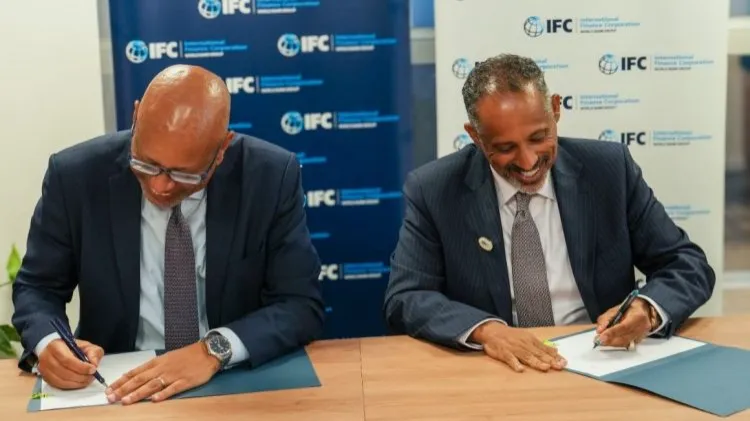
Ethiopian fintech Kifiya Financial Technology has signed its first investment agreement with the International Finance Corporation, the World Bank Group's private-sector arm, in a deal announced November 4 at the Africa Financial Industry Summit (AFIS) in Luanda, Angola. The undisclosed investment will scale Kifiya's AgFinTech operations in Ethiopia and support expansion into Rwanda, Uganda, Tanzania and Kenya, extending an AI-driven credit infrastructure that already sits behind more than $1 billion in financing.
The endorsement carries unusual weight because of what Kifiya's systems have already enabled: financing and insurance access for 1.1 million micro, small and medium-sized enterprises and farmers — including more than 860,000 MSMEs and 230,000 farmers — through risk-decisioning technology that converts alternative data into credit files for borrowers banks have never assessed.
The four-layer machine behind $1bn in credit
Kifiya's technology stack explains the IFC's interest. Its data and AI layer turns more than 42 data families and 10 billion alternative data signals into risk profiles for previously unassessed borrowers. A decisioning layer converts those profiles into credit scores, lending limits, fraud checks and climate-risk screening. A financial layer lets lenders disburse and collect small loans digitally through agents and rural cooperatives, and a market layer links borrowers to buyers, suppliers and services.
The architecture matters because it separates functions that have historically failed in African smallholder finance: origination, underwriting, distribution and risk-sharing. By providing the origination and underwriting intelligence while bank partners carry the loans, Kifiya avoids the balance-sheet trap that has sunk so many African fintechs — lending their own debt-financed capital into a forbearing, climate-exposed customer base — and instead monetises technology per decision.
IFC's strategic shift
The investment is part of a broader IFC repositioning announced at AFIS: backing 15 agritech companies across the continent with equity while deploying portfolio guarantees that connect them to nearly 200 commercial banks. Aliou Maiga, the IFC's Director of Financial Institutions for Africa, told TechCabal on the summit sidelines that the bank-led model marks a departure from the venture-capital structure that pushed startups to lend directly — a structure that "strained balance sheets across the African tech ecosystem."
Stakes on the table are macro-scale. The IFC estimates the continent imports around $90 billion in staple food commodities annually, a flow that directly fuels currency depreciation and sticky inflation. Kifiya's stack addresses the financing gap that keeps domestic production below potential — and its data layer's climate-risk screening gives it a built-in answer to the sector's central risk: loans that default when El Niño-driven droughts fail the crop they financed.
The Ethiopian fintech as a continental platform
Kifiya's expansion plan — talks underway in Rwanda, Uganda, Tanzania and Kenya — tests a proposition that has never quite been proven: that African credit infrastructure can be built once and re-deployed per market. The company says it builds its systems once and configures them for each market's institutions, currencies and regulation, with AI and technology hubs in Nairobi and Cape Town complementing its Addis Ababa headquarters.
Investors have begun pricing this kind of expandability. A fintech that scales into four or five additional markets without rebuilding its stack carries the margin profile of a software company rather than a market-by-market service operator, and IFC's participation — first-time, at the development-finance level — lowers the diligence barrier for commercial investors watching from the sidelines. Each new market adds regulatory expertise, agent networks and data families that increase the platform's optionality.
Why AFIS comes at a hinge point
The endorsement arrives at Africa Financial Industry Summit's most consequential edition, with the continent's bankers gathering in Luanda amid an unresolved question: whether African financial institutions can finance smallholder agriculture at scale without the losses that have historically deterred them. The IFC's model intends the answer to be yes — provided the origination is intelligent enough, the risk-sharing strong enough and the data persistent enough. Kifiya is that thesis's Ethiopian proof case.
The risks that decide the next phase are executional: how quickly the new markets' regulatory approvals land, whether commercial bank partners adopt the underwriting models fast enough to turn guarantees into realised lending, and how the platform's climate-risk assessments perform through their first real drought and bumper-crop cycles. But the direction is unambiguous: the World Bank Group's private arm has just put its balance sheet behind the idea that African smallholder credit solves on data rails, not donor subsidies — and an Ethiopian company built for exactly that problem now has the institution's endorsement to carry it across the continent.
Up next
DRK Backs LbH Plan to Bankroll Ghana Farmers
Ghanaian agritech LbH raises DRK Foundation backing to expand farmer credit data infrastructure after facilitating $5.4m in loans to 13,000 farmers.
More in Business
See all
Lagos, World Bank Target Stronger Governance as Six States Meet Over Public Service Reforms
The two-day meeting, scheduled for November 10–11, 2026, in Ikeja, will bring together government officials and technical...

JobEX Opens Doors to Global Opportunities for Nigerians
For Nigerian users, the Full Access offering is priced at ₦2,999 , providing a relatively modest entry point for users seeking broader...

Dangote Refinery Lifts Petrol Price to N1,300 a Litre
Dangote Refinery raises its petrol gantry price to N1,300 per litre from N1,215 on November 3, with local pump prices rising to about N1,360 as crude costs bite.
About the author
Kelechi Nwachukwu
Business Reporter
Kelechi Nwachukwu writes for BusinessPress.
More by Kelechi Nwachukwu


