
Dangote Refinery Lifts Petrol Price to N1,300 a Litre
Dangote Refinery raises its petrol gantry price to N1,300 per litre from N1,215 on November 3, with local pump prices rising to about N1,360 as crude costs bite.
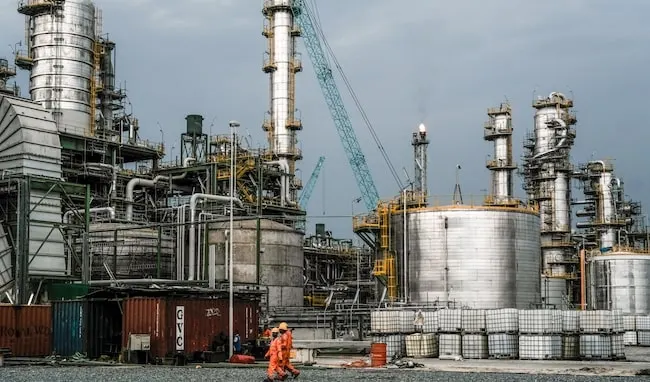
Dangote Refinery has raised its petrol gantry price to N1,300 per litre as of November 3, up from N1,215, according to market reports — a 7 per cent increase at the wholesale point that is already transmitting into pump prices across Lagos, where depot prices range from N1,283 to N1,318 and NNPC and MRS-affiliated stations sell at about N1,360. The move marks the largest step-change at the gate of Africa's largest single-train refinery since its early-2025 commissioning phase and lands just as Nigerian households and businesses brace for the year-end transport and logistics surge.
The economics of the adjustment are straightforward and demand-side driven: the refinery prices its gantry output against import-parity and the cost of crude feedstock, and global Brent crude has spent the week near $100-104 per barrel, roughly 70 per cent above the start of the year. Every increment of crude cost feeds directly into refining margins, and with import competition now largely marginal after the refinery's scale-up, Dangote's gantry effectively sets the domestic benchmark.
What the gantry price means at the pump
The transmission chain from refinery to forecourt is visible in current Lagos pricing. Depot prices — what bulk buyers pay midstream — run from N1,283 to N1,318 per litre, above the refinery's own wholesale rate, reflecting logistics and depot margins. Retail prices add transport, taxes and station margins, which is why NNPC retail and MRS outlets in Lagos have printed around N1,360 and Mobil at N1,349. For consumers outside Lagos, where distances and distribution frictions are greater, pump prices typically exceed these levels, so the practical effect of the N85 gantry rise is higher everywhere it lands.
The timing compounds the effect. November and December are the peak-mobility quarter in Nigeria: Christmas travel, food logistics into urban centres and energy use for generators all peak, so a fuel-price step-up arrived after the rice-and-eggs price pressures already being reported in markets this season. Nominal incomes have been supported by recent wage and relief measures — including the newly launched six-month N70,000 transport allowance for civil servants — but fuel is a first-order cost across virtually every sector of the economy, meaning pump-price inflation arrives before household budgets adjust.
Inflation mathematics and the disinflation threat
Fuel is the single largest pass-through item in Nigeria's consumer price basket, given its role in food transport, generator electricity and inter-city logistics. Nigeria's headline inflation has been falling steadily — 14.63 per cent in September, down from 15.39 per cent in August — but the gain is vulnerable to exactly this kind of first-quarter repricing in energy. Every N100 added to the national average pump price historically feeds into headline CPI through food distribution costs and transport fares within one to two months, and with food inflation already at 19.59 per cent, further upward fuel pressure makes the October and November inflation prints harder to call.
For the central bank, the sequencing complicates the easing cycle built on the historic 350-basis-point cut in September. The Monetary Policy Committee's disinflation assumption relies on continued moderation of fuel-related inflation; a sustained energy-price step-up would test that assumption and keep rates higher for longer than markets currently price.
The refinery's margin logic
From Dangote's standpoint, the increase also defends profitability in a market where the refinery's feedstock — imported crude — is itself reaching records in dollar terms. The refinery has navigated a complex two-year journey from import-parity setter to domestic competitor, reportedly selling export product at international premiums, and its N1,300 level still represents a discount to pure import-parity in many months of 2026 — the reason domestic pump prices remain far lower than some of the previous import-era peaks recorded in 2024. But the company's huge capital-expenditure base and its role in the country's wider industrial buildout mean feeding the facility at cheaper crude is not on offer.
The bigger read is about the domestic petrol market's structure. As Dangote's output sets a domestic price benchmark and import shares have fallen, Nigeria's petrol price experience is increasingly a function of crude markets rather than before-the-fact Naira and subsidy distortions: energy costs now move with Brent. That is, from an investor's perspective, a market-clearing mechanism — and from a household's perspective, a guarantee that the global oil price remains the single most important variable in Nigerian cost-of-living policy.
What industries and investors should watch
For logistics and FMCG companies, the increase arrives in the quarter where freight costs collide with festive demand, so watch pass-through in food retail prices and transport fares. For airlines and transport operators, jet fuel and diesel follow the same crude logic. For the currency, higher fuel-linked import substitution — assuming the refinery's domestic supply growth continues expanding — theoretically reduces FX drain, cushioning the naira at N1,349; but the refinery itself purchases crude through the official market, meaning crude buying demand on the CBN's books is a countervailing flow investors must monitor in quarterly data.
For the coming quarter, the central question is whether the N1,300 gantry price holds or drifts higher again with Brent. Nigerian households got a cost-of-living break this year only because pump prices decoupled from their 2024 highs; that break is now being tested by the world's oil price, not by domestic policy — the most important change in Nigeria's energy economics for a generation.
Up next
FG Rolls Out N70,000 Transport Allowance for Workers
The federal government begins a six-month N70,000 monthly transport allowance for public servants, backed by the NLC but rejected by the TUC, alongside NERSI cash payments.
More in Business
See allCITA Energies Seeks Review of Dangote Refinery's Jet A1 Pricing Formula
Aviation fuel marketer CITA Energies has called on Dangote Refinery to review its Jet A1 pricing formula, a premium introduced in March and a requirement that 25% of buyers' payment instruments be placed under lien, saying the extra costs are passed on to airlines.
Zimbabwe Approves $650 Million Floating Solar Plant on Lake Kariba
Zimbabwe's Cabinet cleared a 600MW floating solar project on Lake Kariba for implementation, with GreenGrid Energy as developer and ZETDC as sole off-taker.
Niger Gives Chinese Oil Partners 45 Days to Repatriate $5.2 Billion in Export Revenue
Niger's military-led government told CNPC, WAPCO and SORAZ to return more than $5.2 billion in crude export revenue and meet local-content commitments within 45 days.
About the author
Amaka Obi
Senior Business Reporter
Amaka Obi writes for BusinessPress.
More by Amaka Obi


