Aviation Ministry Approves Lagos Airport Monorail Design as Financing Talks Advance
The five-stop line from Ikeja Railway Station to Murtala Muhammed International Airport Terminal 1 has an approved design but no published cost or construction schedule, while the terminal reconstruction it is meant to serve is already under way.
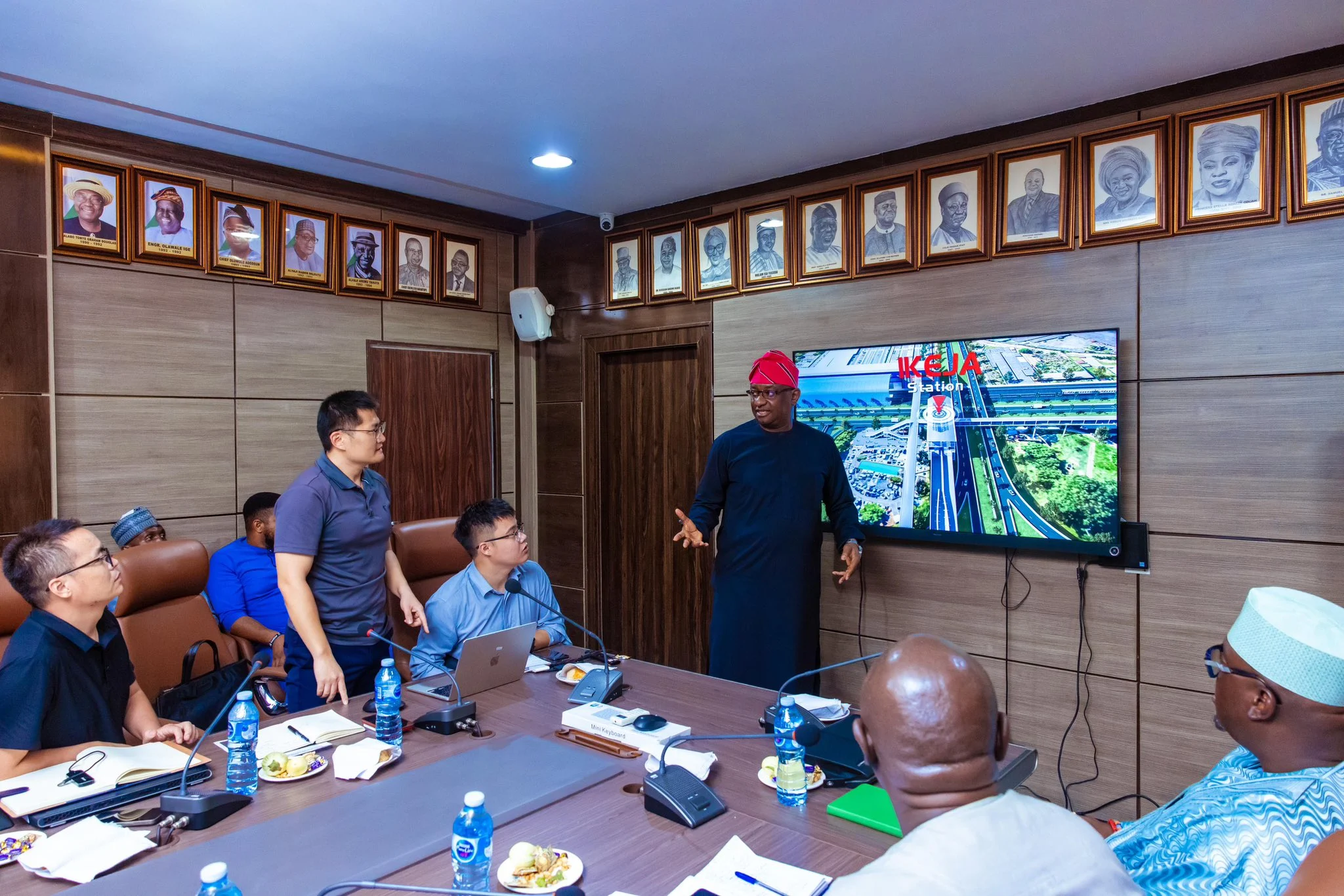
The aviation ministry has approved the design of a proposed monorail linking Ikeja Railway Station, where the Lagos Red Line terminates, to the terminal point at Murtala Muhammed International Airport Terminal 1 in Lagos, a line the minister says is integral to the reconstruction of the country's main gateway.
Festus Keyamo said on Tuesday that he appraised and approved the design alongside the permanent secretary of the Federal Ministry of Aviation, the managing director of the Federal Airports Authority of Nigeria, Olubunmi Onabanjo-Kuku, and engineering teams from the ministry and the authority. He said the line would have five stations: Ikeja Station, Domestic Airport Station, Beesam Station, Toll Gate Station and MMIA Airport Station.
The approval follows a June announcement that the ministry was collaborating with the Lagos State government to extend the state's rail line through key airport terminals, running from Ikeja past the general aviation terminal and Murtala Muhammed Terminal Two to the international terminal. The FAAN managing director said on October 18, at the World Aviation Festival in Lisbon, that discussions on financing the planned airport rail link had reached an advanced stage. Keyamo's statement set out no construction date and no completion timeline.
Design is not financing
The distinction matters because the aviation ministry has spent the better part of two years producing designs for Lagos airport access and has, so far, produced no construction. The plan to extend the Lagos Red Line into the airport complex was announced in June; the monorail design was appraised on October 20; and as of the announcement, the money is described as under negotiation at an advanced stage, with no structure disclosed and no schedule published. Design approval is the cheapest step in the sequence and the one with the least procurement risk attached.
For a public infrastructure project of this kind, the question that determines everything is who carries the capital and the operating risk, and the answer shapes what gets built. A monorail can be delivered as a public works project, financed through the federation's infrastructure budget and maintained by the authority, or as a concession or public-private partnership in which a private operator funds and runs the line and recovers costs from fares or from an availability payment. The second route is faster to start and harder to end badly; the first is slower and puts the risk with the budget that has just managed to fund the terminal reconstruction itself.
The absence of a published figure is the concrete item to watch. A monorail from Ikeja to the airport with five stations is not a small asset, and any credible costing would let the public judge whether the passenger-time saving justifies it, which is the argument the project rests on.
Why rail, and why a monorail
The transport case for the link is about time rather than distance. The road corridor between Ikeja and Murtala Muhammed International Airport is one of the most congested in Nigeria, and every hour of airport access time is a cost borne by passengers, by cargo handlers and by the airlines that price their schedules around it. Lagos has already built the Red Line to Ikeja, which means the demand-side decision to shift airport traffic onto rail has been taken once; the monorail extends that decision across the final leg.
A monorail rather than a full heavy-rail extension is the cheaper way to close that final leg. Monorails can be built on a single beam, which is faster to erect in a congested corridor with limited right-of-way, and they can be delivered in sections without closing the airport road network for long periods. The trade-offs are capacity, where a single-track system handles fewer passengers per hour than a heavy-rail line, and the absence of any onward network beyond the airport. For an access line whose entire purpose is to feed the terminal, the capacity ceiling is less binding than the construction risk, which is presumably why the monorail format was chosen.
Whatever is chosen, the six-kilometre-scale constraint is real and it belongs to Lagos State. The Red Line is the state's project, with the federal government as partner, and the monorail has to interface with it at Ikeja and with the airport terminal approach roads at the other end. Two authorities, two sets of engineering standards and two sets of commercial expectations have to be reconciled before the first column is poured, and that reconciliation is not visible in the announcement.
The terminal and the line have to arrive together
The sequence is the part most likely to be got wrong. Terminal 1 is being reconstructed while international operations continue through temporary arrangements, and the monorail is described as an integral part of that reconstruction. If the terminal opens before the line is built, the airport will have absorbed the disruption of its reconstruction without the offsetting benefit, and the monorail's ridership case, which is built around recovering the traffic that the road cannot carry, will have to be argued from a lower base and against a terminal that is already operating.
There is also the aviation cluster argument. The settlement with Bi-Courtney Aviation Services, approved by the Federal Executive Council, restores the government to a revenue position at Terminal 2 and is expected to see regional flight operations relocated to MM2 subject to available capacity. A rail link that serves MMIA Terminal 1, MM2, the general aviation terminal and the domestic terminal changes the airport into a single connected interchange rather than four separate road-facing facilities. For an airline setting up a hub or a cargo operator moving freight through the Lagos gateway, that is a commercial argument that extends well beyond the passenger time saved.
The aviation minister's wider programme points the same way. Alongside the terminal reconstruction and the rail link, the ministry has moved to establish an aircraft leasing company backed by international investors to address the constraints that have limited Nigerian carriers' fleet expansion and kept them dependent on foreign lessors. A connected airport with predictable access times is part of the same proposition as locally owned aircraft: both remove a dependency that currently costs the country money.
What to watch
Four items will separate a design approval from a working line. The financing structure and its amount, since the FAAN managing director has said discussions are advanced but has not said with whom or on what terms. The operator, which determines whether the line is a public service or a concession with a revenue model. The construction timeline against the Terminal 1 reopening date, because the two must be sequenced or the airport will open first. And the fare or access policy, since a link that costs more than a taxi for a family travelling with luggage will not shift the behaviour the project needs in order to work.
There is no timeline in the announcement and no cost. What exists is an approved design, a station list, an assurance that financing is close, and a terminal reconstruction that is already under way. Lagos has been promised airport rail since June. The monorail moves that promise a stage further, and the distance between an appraised drawing and a running train is where the remaining risk sits.
Up next
Nigeria Confirms First Bundibugyo Ebola Case With 44 Contacts Under Monitoring
Laboratory tests confirmed the Bundibugyo strain in a woman who arrived from Uganda on October 3 and fell ill four days later, with 44 contacts identified, no vaccine available for the strain and WHO recommending no travel or trade restrictions.
More in Business
See all
Nigeria's $350m Solid Minerals Exports Face Value-Addition Hurdle
The country ships raw ore while importing processed products, ceding the industrial and jobs gains that processing would create, industry observers warn.

Nigeria Accounts for $131bn of Africa's $209bn Business Financing Gap
A study by BII and Swedfund found a $209 billion financing gap for Black-owned businesses across five African economies, with Nigeria accounting for $131 billion.

Tinubu approves 30% fee relief for airlines as jet-fuel costs bite
The discount applies to outstanding statutory fees owed to aviation agencies and is intended to steady carriers facing a sharp rise in Jet A1 prices.
About the author
Yaw Boateng
Corporate Reporter
Yaw Boateng writes for BusinessPress.
More by Yaw Boateng