
Nvidia and Korea’s Rebellions Build Sovereign AI Racks With SK Telecom
The deal fuses Korean-made NPUs into Nvidia’s rack platform using NVLink Fusion, with systems deployable from 2028 under the science ministry’s blessing.
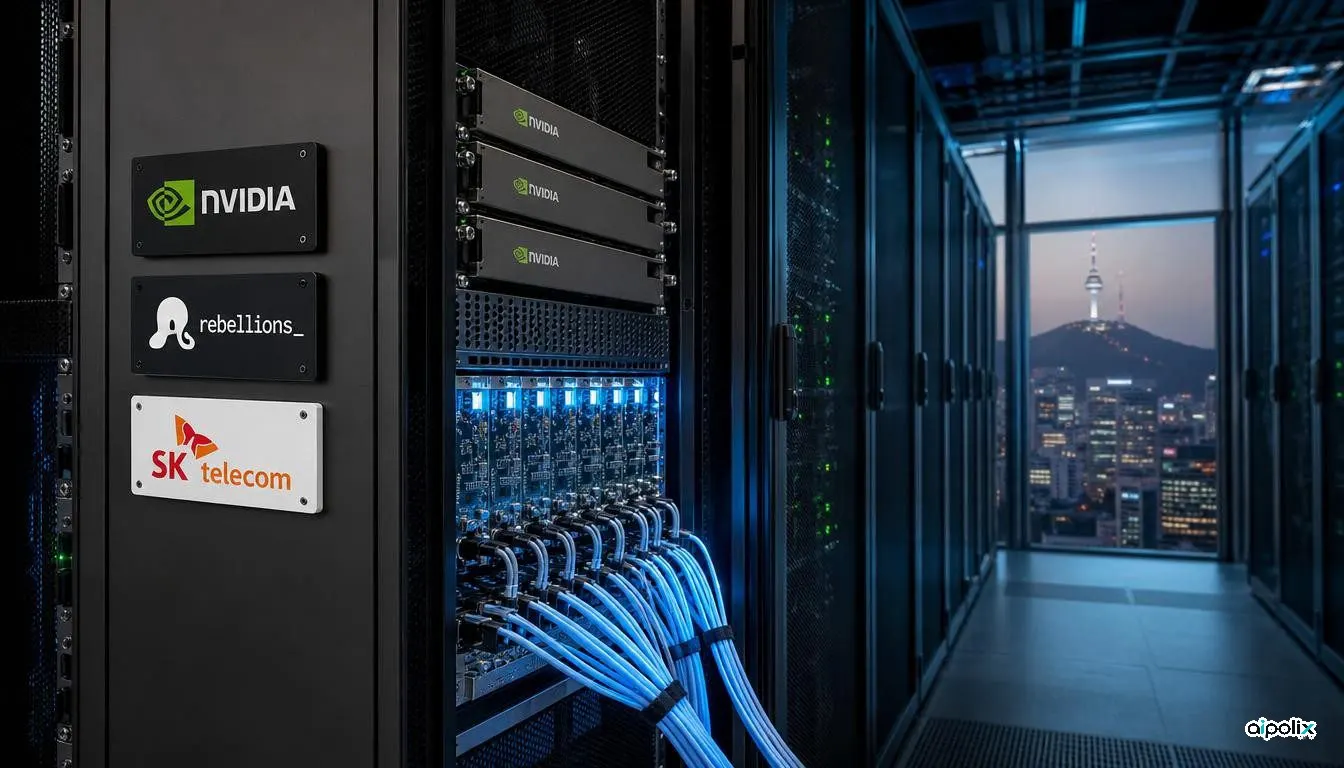
Nvidia, SK Telecom and South Korean AI-chip maker Rebellions have agreed to build sovereign AI infrastructure that embeds homegrown Korean NPUs into Nvidia's own rack-scale computing platform, an arrangement announced ahead of Nvidia AI Day Seoul Monday and backed by Korea's science ministry — the clearest commercial signal yet that the AI buildout's next expansion is designed to multiply, not displace, national chipmakers.
Under the memorandum, Rebellions will use Nvidia's NVLink Fusion technology to connect its Rebel and Rivel R200 neural-processing units directly to Nvidia's computing platform, building MGX rack-scale inference systems; SK Telecom will deploy those systems across its AI data centres, running its own models — including the A.X K2 Korean-language large language model — and powering the government's "AI for All" public-services project. Korean Science and ICT Minister Bae Kyung-hoon called the step a milestone for "Korean NPUs entering the global AI-computing market."
What NVLink Fusion changes
The architecture matters as much as the deal. NVLink Fusion, which Nvidia opened to third-party silicon earlier in the cycle, lets any qualified national chipmaker weld custom accelerators into Nvidia's rack ecosystem rather than forcing them to compete at the system level against the incumbent's full-stack products. Jensen Huang's own framing makes the strategy explicit: "With NVLink Fusion, Korea's chipmakers can connect their custom ASICs to NVIDIA's AI factory platform" — a model under which Nvidia keeps the platform (and the interconnect economics) while partners build the specialised compute on top.
For Rebellions the integration is a distribution breakthrough rather than a subsidy: the startup's NPU design can now reach sovereign deployments under Nvidia standards documents, with systems deployable from 2028. The company's own disclosure of more than 4 billion daily tokens inside a major carrier deployment is the domestic revenue base that earns it a place in the sovereignty build — and the 2026 edition timeline shows how fast the sequencing moved: an April SKT-Rebellions-Arm memorandum, a July Nvidia-SK Group expansion, August's Nvidia-Rebellions discussions, and the November commercial agreement.
Sovereign AI as the buildout's next frontier
For the global AI trade, the announcement's significance is the sovereignty model's scale. Countries now treat national AI computing capabilities as infrastructure on par with electricity grids and telecoms, and the countries that build their own spines — Korea with its domestic chipmakers, Gulf states with sovereign compute funds, and emerging markets with the ambition — are increasingly organising their procurement around a hybrid: Nvidia's base layer fused with domestic accelerators for workloads where state data, national languages or security boundaries prevent pure-cloud routing.
Nigeria's and Ghana's equivalents — Nigeria's National Sovereign Cloud Initiative treating "data centres as the refineries of the digital economy", Ghana's own sovereign-AI ambitions, and Kenya's data-localisation requirements — are at earlier stages of the same pattern, and the Korea model offers them a financing and procurement template: choose a base-layer platform, localise the specialized compute through domestic or regional chip partnerships, and route public-sector demand through the stack to guarantee a volume revenue base from day one.
The market context: a fragile rebound week
The announcement lands inside a fragile market. Asia's chip complex rebounded hard Monday — TSMC up roughly 5.6 per cent in Taiwan, Tokyo Electron adding about 3 per cent in Tokyo, Nikkei bouncing 3.5 per cent from the prior Friday's 6 per cent rout — with the Korean Kospi gaining more than 1.8 per cent after its own 6 per cent plunge. Nvidia itself closed Friday up 2.8 per cent, though the week's horror of margin-call selling has left the sector's broader index the Philadelphia Semiconductor up just 4.2 per cent in a recovery session that remains hostage to this week's earnings calendar.
Nvidia's other current — the board's independent investigation of CEO Jensen Huang over foreign-intelligence allegations, with Congress's Nov 18 briefing a day after Q3 earnings — carries its own exposure to the Korea partnership's timing, suggesting the company's global partner network has been being built on the credibility of its governance. For SK Telecom, the sequencing matters: the Korean carrier is the anchor buyer of the first NPU-fused sovereign deployment, meaning the Korean ecosystem is now Nvidia's R&D-and-deployment partner, and rather than a Korean copy, the market gets its first real test-case of the sovereignty buildout.
What the deal means for the supply chain
Practically, the deal accelerates three supply chains. First, Korean fabless design: Rebellions' hiring and tape-out calendar through 2028 depends on the Nvidia standard documents, growing the domestic design chain around what Samsung and SK Hynix already dominate in memory. Second, rack integration: the MGX ecosystem's local integrators — the data-centre fabric builders — become the recruiting ground for sovereign-deployment expertise, which cannot be imported. Third, utility: SKT's data-centre builds are priced off domestic electricity and grid commitments, and a national AI build at meaningful scale is a load-growth investment Korea's utilities plan for.
For global markets, the Korea template matters because it is exportable: the next three years will show whether the sovereignty buildout becomes a standard model in which every country pairs its local accelerator ecosystem with a base-layer partner, or whether only the four or five most developed domestic-chip nations can actually sustain that architecture. Seoul's is now the best-documented case study of the model working at scale.
Up next
New Congress Prepares a Flood of AI and Data-Centre Legislation for January
Reuters reports Democrats plan AI-systems and data-centre bills when Congress convenes, with Bloomberg noting the AI-chip export regime is a direct focus.
More in Technology
See all
Axon Falls 18% After Betting $1.2bn on Skydio
Axon tumbles 18.2% on weak quarterly results compounded by a $1.2bn investment in drone autonomy firm Skydio, resetting the public-safety tech debate.

Cloudflare Surges 20% After Raising Sales Outlook
Cloudflare jumps 20% after Q3 revenue and adjusted earnings beat expectations and it raised its sales outlook, upending the AI-capex panic narrative.

IREN Jumps 20% on Fresh AI Data-centre Contracts
Data-centre developer IREN surges 20% after results beat estimates and it discloses two new contracts signed since quarter-end, defying AI-spend slowdown fears.
About the author
Chinedu Nwosu
Technology Editor
Chinedu Nwosu writes for BusinessPress.
More by Chinedu Nwosu


