CoreWeave Yields Top 15% as AI Junk Bond Market Shows Signs of Freezing
CoreWeave's junk bonds are yielding more than 15% and its credit default swaps have blown past 1,100 basis points, signs that investors are losing confidence in the AI infrastructure company's ability to service roughly $50 billion of debt.
Borrowing costs for CoreWeave, one of the most heavily indebted companies in the artificial intelligence infrastructure boom, have spiralled to levels that typically signal acute distress, with its junk bonds now yielding above 15 per cent and credit default swaps passing 1,100 basis points.
The swap level implies investors see something close to a 60 per cent probability of default over the medium term, according to market estimates cited by Bloomberg in a report on Friday that described the AI-linked high-yield market as close to a freeze. CoreWeave's chief executive has publicly called the market reaction "irrational" as both shares and bonds slumped to prices that usually indicate restructuring territory.
A debt pile built for the AI race
CoreWeave rents out clusters of graphics processing units to companies building and running AI models, expanding at extraordinary speed by borrowing against contracts and data centres rather than waiting for internally generated cash. The strategy has left the company with roughly $50 billion in debt obligations, according to Bloomberg's tally, at a moment when the revenue growth that justifies the spending is still being proved.
The company's bonds were sold to yield-hungry investors during the credit-fueled expansion of the past two years. As prices have fallen, the yields demanded by new buyers have risen so sharply that refinancing existing debt at manageable rates has become difficult, creating the classic stress loop that has taken down leveraged borrowers in previous cycles.
Why a single borrower can freeze a market
CoreWeave is not large enough on its own to threaten the financial system, but it matters as a benchmark. Several other AI data centre operators, cloud providers and chip-dependent borrowers have sold bonds on similar assumptions: that explosive demand for computing will keep revenue growing faster than interest bills.
When one prominent borrower's credit spreads blow out, investors reprice the whole cohort. Bankers report that issuers hoping to sell new debt are now postponing deals, and the risk is a funding gap precisely when capital expenditure on AI is at its peak. That dynamic is what Bloomberg's report meant by the AI junk market freezing: not silence, but a market where only the strongest credits can borrow at any sane price.
The profit question underneath
The dispute ultimately turns on whether AI infrastructure earns returns that justify its cost. Optimists point to multi-year contracts with large technology firms; sceptics note that much of the demand rests on a handful of customers, some of them also investors in the companies that lease capacity to them. Rating analysts have warned that cash flows will be tested as original contracts roll over and as cheaper computing comes online.
What to watch
Three markers will decide the next move: CoreWeave's next quarterly disclosures on contract revenue and interest cover, whether it can complete any refinancing, and the behaviour of the wider high-yield market, where borrowing costs for all but the safest issuers have started to drift higher. For investors in Nigeria and elsewhere with exposure to global bond funds, the stress is a reminder that the AI trade is no longer a one-way bet.
Up next
Brent Crude Hits Highest Level Since May After Tankers Struck by Mines in Hormuz
Brent crude jumped 3.7% to $109.86 a barrel after tankers were hit by mines in the Strait of Hormuz, the highest level since mid-May, prompting emergency supply measures from the IEA and the United States.
More in Technology
See all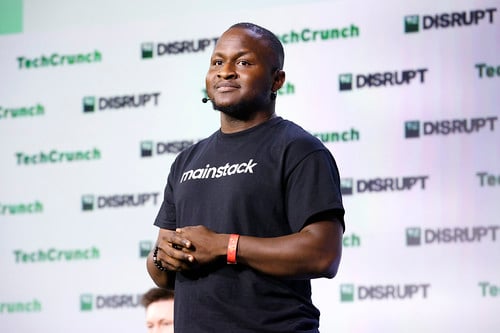
Mainstack CEO Says Nigeria Must Measure Startups by Revenue, Not Raise Rounds
Mainstack chief Ayobami Oyaleke is urging Nigeria's startup ecosystem to judge success by revenue, retention and risk management rather than funding volumes, warning against over-reliance on debt.
Onafriq Winds Down Baxi Agent Banking in Nigeria After Five Years
Onafriq is closing Baxi, the agent banking business it acquired in 2021, citing inflation, naira depreciation and the rise of instant account-to-account payments, while insisting it is not exiting Nigeria.

LincRide Launches WhatsApp Ride-Hailing in Lagos With 3,000 Drivers
Nigerian mobility company LincRide launched an on-demand ride-hailing service in Lagos bookable entirely through WhatsApp, with more than 3,000 verified drivers.
About the author
Chinedu Nwosu
Technology Editor
Chinedu Nwosu writes for BusinessPress.