Firms Should Buy Dollars From the Market, Not CBN Allocations — Dangote Tells Economic Summit
Billionaire industrialist Aliko Dangote told the 32nd Nigerian Economic Summit in Abuja on Monday, October 26, that companies should be able to buy foreign exchange through the market at prevailing rates rather than rely on direct Central Bank of Nigeria allocations, warning that naira cash alone does not solve machinery import needs.
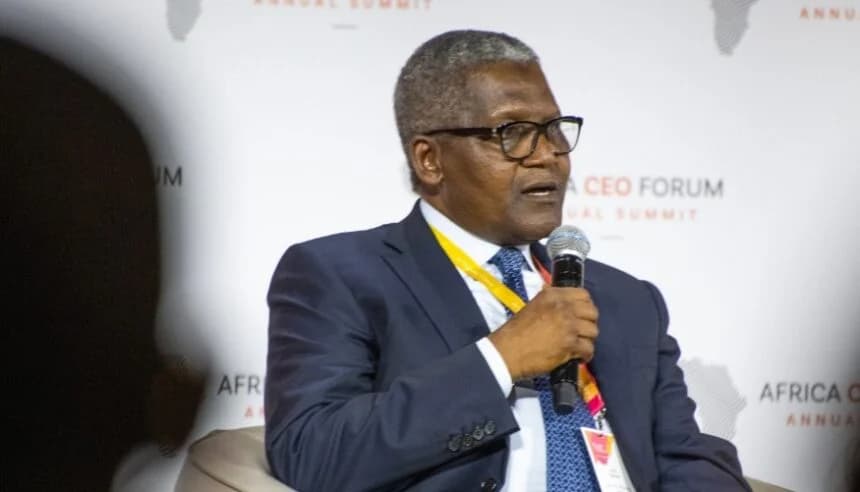
President of the Dangote Group, Aliko Dangote, told the 32nd Nigerian Economic Summit in Abuja on Monday, October 26, 2026, that Nigerian companies should be able to buy foreign exchange through the market at prevailing rates instead of depending on direct Central Bank of Nigeria allocations, BusinessDay reported. His warning was pointed: a company can have all the naira it requires and still be unable to obtain the dollars it needs for machinery, so access design matters more than aggregate currency supply.
The intervention lands at the centre of this year’s most consequential FX question. The reform era unified Nigeria’s exchange windows and moved price discovery to the Nigerian Foreign Exchange Market, where the official rate held near ₦1,331.28 per dollar on Monday after recovering from Friday’s slide, Nairametrics reported. But behind that surface stability, corporate buyers of dollars for capital equipment still navigate documentation queues and timing frictions that shape capital expenditure decisions far more than the daily fixing does.
Dangote’s group is uniquely credible on the point. The Dangote Petroleum Refinery — which absorbed the country’s largest industrial machinery import programme in a generation during its construction — consumed FX at scale through precisely the allocation dynamics the industrialist is criticising, and its sponsors have spoken publicly about the cost of FX friction in project execution.
[irp][irp][irp][irp][irp]
What Market-Determined Access Would Change
The distinction between allocation and market access is not cosmetic. Allocation-based FX supply is chronically opaque: buyers cannot see the queue, cannot price their expected acquisition timing, cannot hedge their currency exposure on defined terms and cannot plan equipment procurement on a fixed timetable. Market-based access, in principle, solves all four problems by letting buyers meet sellers transparently at discoverable prices — the exact design principle the 2023 reform programme was built on.
Nigeria’s FX data shows why the demand matters now. The Central Bank’s Q2 2026 Statistical Bulletin, published this week, put net foreign exchange flows at $22.50 billion for the quarter, the highest since Q4 2019, according to Nairametrics — a liquidity base that could, in principle, support genuine two-way markets for corporate buyers without the rationing that allocation systems imply.
The Political Economy of the Ask
The CBN has historically resisted open-ended market access for equipment buyers partly because unrationed windows are vulnerable to round-tripping, over-invoicing and speculative accumulation — abuses the bank has spent years policing through validation frameworks. The design tension is real: honest importers want speed and transparency, while the regulator wants traceability. Other currency markets have evolved solutions — pre-declared end-use, audit trails, two-way quoting — and whether the CBN’s next FX circular loosens access without re-creating the arbitrage of the pre-2024 era is the operational question.
The framing also sits inside a competitive context. If the country’s largest manufacturers, whose investment plans define the non-oil economy’s capital outlook, publicly push for market access just as the summit convenes, the central bank faces measured pressure on both sides of the ledger — friction going forward against the documentary controls it maintains.
The Line Investors Should Watch
Three data streams will show whether the message lands. Corporate earnings commentary this reporting season, where FX access friction shows up as capital-expenditure remarks. The NFEM’s own market depth, where turnover concentration and bid-ask behaviour are the practical measures of access. And the CBN’s next policy FX announcements. Dangote’s summit intervention makes that convergence explicit; the market will now watch what follows.
Up next
NGX Flags Nine Firms for Delisting and Restructuring as Union Dicon Faces Deadline
The Nigerian Exchange has moved to flag nine listed companies for delisting, restructuring or other corporate actions, with Union Dicon Salt among the firms whose statuses changed on the Exchange’s daily register, Nairametrics reported on Monday, October 26.
More in Finance
See all
CBN offers N2trn OMO bills as banks park over N6trn at deposit window
The Central Bank of Nigeria offered N2 trillion in OMO bills on October 22 as commercial banks continued to hold more than N6 trillion at the standing deposit facility.

Abbey Bank set to begin full commercial operations in November as CBN approves upgrade
Abbey Bank transitions from mortgage bank to full commercial bank with approval from the CBN.

Banking system braces for N2.86trn OMO maturities as liquidity surges
Large OMO maturities are set to hit the system as liquidity remains elevated and CBN manages absorption.
About the author
Amina Suleiman
Finance Correspondent
Amina Suleiman writes for BusinessPress.