IMF Sees Sub-Saharan Africa Growing 4.5% in 2026 as Aid Flows Shrink
The IMF's October Regional Economic Outlook upgraded Sub-Saharan Africa's 2026 growth forecast to 4.5% while warning that bilateral aid will fall another 12% after dropping about a quarter in 2025.
The International Monetary Fund (IMF) expects Sub-Saharan Africa to grow by 4.5 per cent in both 2026 and 2027, an upgrade from the 4.3 per cent it projected in April, but warned that bilateral aid to the region is set to fall by a further 12 per cent this year after dropping by roughly a quarter in 2025. The forecasts were released on Thursday in the fund's Regional Economic Outlook Update for Sub-Saharan Africa, published during the IMF-World Bank Annual Meetings in Bangkok.
The IMF said global supply adjustment, favourable export receipts in some countries and earlier reforms helped cushion the shock of the war in the Middle East. But it cautioned that steady headline growth masks widening divergence between countries, with slowing activity in non-resource-intensive economies and continued resilience in resource-intensive ones.
Growth upgraded, but the inflation picture has worsened
The growth upgrade came alongside a deterioration in the fund's price projections. Median inflation in the region is now expected to rise from 3.4 per cent in 2025 to 4.3 per cent in 2026 and 5.0 per cent in 2027, a reversal from April, when the IMF had expected price pressures to peak at 5.0 per cent in 2026 before easing. The fund linked the shift to higher energy and food prices driven by supply shocks and to the persistence of price pressures in individual economies.
Interest payments now absorb about 12 per cent of government revenue across the region, according to the report, while the US 10-year Treasury yield climbed from 4 per cent in late February to 5.2 per cent by end-September, lifting borrowing costs even as sovereign spreads narrowed. The IMF said pre-war fiscal adjustment and declining debt ratios remain important achievements, but that high interest burdens and low reserves in many countries leave limited room to absorb another shock.
The external accounts of oil exporters and importers are pulling apart. The fund projects oil exporters' current account surpluses widening to 4.4 per cent of gross domestic product from 1.6 per cent, while non-resource-intensive economies see deficits widen to 5.8 per cent from 3.4 per cent, a sharper divergence than flagged in April.
Aid keeps falling, leaving little fiscal buffer
Aid is the sharpest change in the outlook. Development assistance for the continent fell sharply last year and is forecast to decline another 12 per cent in 2026, Zeine Zeidane, the IMF's Africa department director, told reporters in Bangkok. "That leaves the region with little room to absorb another shock. Renewed disruption to energy supplies, a sharp increase in global risk aversion, or a strong El Nino could all intensify pressures," he said.
The fund's April work on the same subject found that African bilateral aid budgets were cut by between 16 and 28 per cent in 2025 relative to 2024 levels, and that the contraction is larger, more synchronised across countries and predominantly donor-driven rather than a response to conditions in recipients. Sub-Saharan Africa remains the most aid-dependent region in the world, with official development assistance close to 3 per cent of regional GDP in 2024, more than twice the share of the next most reliant region.
The countries with the least fiscal space are the most exposed. Low-income states and fragile conflict-affected economies receive aid worth 6.4 and 6.0 per cent of GDP respectively, against 0.4 per cent for emerging market economies in the region, and more than half of aid flows to the region finance health, education and basic humanitarian assistance.
Nigeria upgraded as the fund flags downside risks
For Nigeria specifically, the IMF raised its 2026 growth forecast to 4.2 per cent, citing a favourable terms-of-trade effect from higher oil prices, with 4.3 per cent projected for 2027. Services remain the principal domestic driver of activity, and the fund's Nigeria team has pointed to stronger foreign exchange receipts and improved reserves as supporting liquidity.
The regional risks remain tilted to the downside, the report said, listing renewed energy supply disruption, a sharp rise in global risk aversion, further aid reductions and a strong El Niño among the scenarios that could undo recent gains. The IMF's policy prescription is correspondingly narrow: continue fiscal adjustment, save temporary commodity windfalls rather than spending them, target support to vulnerable households, contain persistent inflation and protect productive investment so that private-sector growth can create jobs.
The practical tension for finance ministers in the region is that the same commodity boom supporting growth and exports is also the last reliable source of revenue as aid retreats. Whether governments bank those windfalls or convert them into recurring spending commitments will go a long way to determining whether the 2026 forecast holds or whether the next shock lands on budgets that have already spent their margin.
Up next
Guinea Insurance shares rally 43% in October 2026
Guinea Insurance shares have risen 42.86 per cent in October 2026, breaking eight months of declines, as the company's recapitalisation and fresh capital raise investor interest despite a wider H1 loss.
More in Economy
See all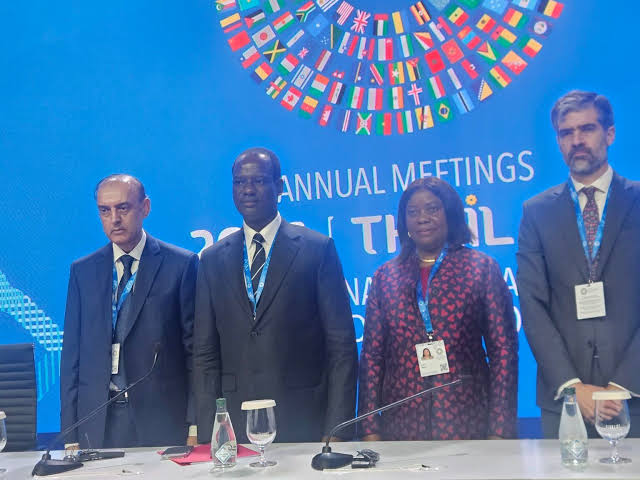
G-24 Warns Developing Nations Pay $500bn More for Debt Than Rich Countries
G-24 chair Taiwo Oyedele said developing countries pay about $500 billion more for debt than developed economies, urging cheaper IMF and World Bank financing.
Nigeria spent N5.28tn on domestic debt service in H1 2026
Nigeria spent N5.28 trillion servicing domestic debt in the first half of 2026, with interest and rental payments accounting for N4.95 trillion, according to the Debt Management Office.
Nigeria's Inflation Eases to 14.63% in September as Food Prices Fall
The NBS said headline inflation dropped to 14.63% in September from 15.39% in August, with month-on-month food prices falling 1.55% and core inflation at 12.95% year-on-year.
About the author
Fatima Bello
Analysis Editor
Fatima Bello writes for BusinessPress.
More by Fatima Bello
DP World and TGI partner to strengthen Nigeria logistics
Corporate4 hrs ago