
Cocoa Futures Hold Near 5,467 Dollars on West Africa Weather
Cocoa futures firmed to about $5,467 per tonne as Reuters cited unfavourable West African weather, keeping supply anxiety alive.
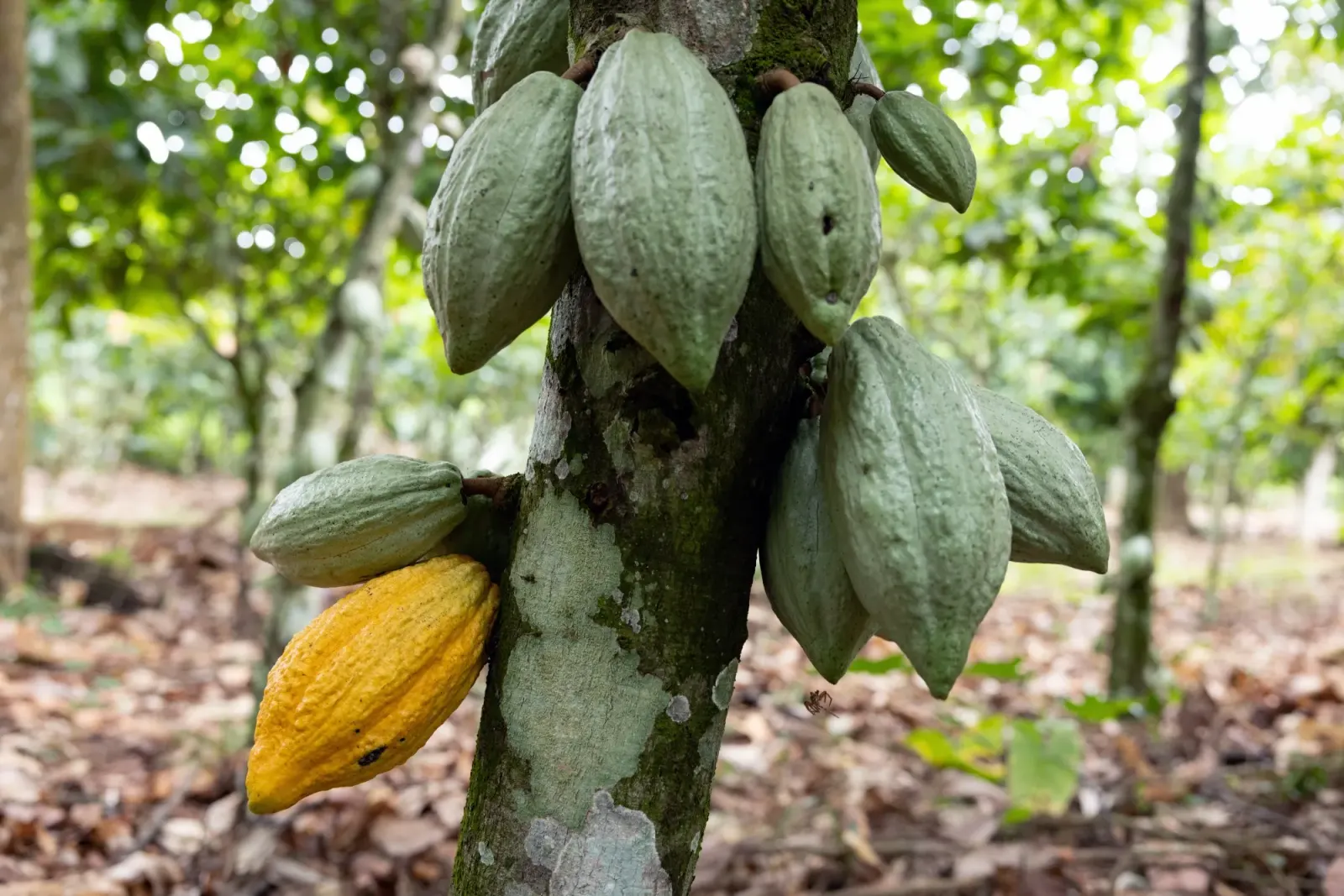
Cocoa futures held near $5,467 per metric tonne this week as unfavourable weather in West Africa — the region that supplies the world's chocolate industry — re-established the supply anxiety that has defined the cocoa market through its historic price cycles, with Reuters citing the conditions as the driver behind fresh demand.
The market's fragility is spatial as well as meteorological: the global cocoa trade is structurally dependent on West Africa at levels no other agricultural commodity matches, with Côte d'Ivoire, Ghana, Nigeria and Cameroon supplying roughly two-thirds of the world's beans. Weather that disturbs the region's main-crop development transmits almost instantly into international futures, and every forecast model that turns dry — or wet — over the Gulf of Guinea references the same calculation.
Where prices sit in a historic context
Levels near $5,400 per tonne need context, because cocoa's price history is unusual. The international market traded in a band of $2,000 to $3,500 for the decade to 2023, before a combination of harvest failures — El Niño-driven dryness, disease pressure, and the ageing tree stock in the largest producers — forced prices to historic extremes above $10,000 per tonne during 2024. The subsequent normalisation has been partial and fragile: prices remain well above the pre-crisis band, and the 2026 crop's development path has so far failed to rebuild the comfortable stock-to-use ratios that anchor most agricultural markets.
The reason for that fragility is arithmetic. Supply shortfalls hurt more than surpluses help, because cocoa demand — chocolate manufacturing with its festive and daily-consumption base — is relatively insensitive to price in the short run. Manufacturers verify their grinding activity: when the world's cocoa grindings data releases show producers still processing at elevated rates even at high prices, traders read it as evidence that the demand destruction needed to cap prices simply has not arrived — which is why a 0.26 per cent daily rise was enough to keep this week's narrative alive.
Nigeria's position in the recovery story
Nigeria is the region's third-largest producer, and its cocoa economy has been the focus of a quiet renaissance through the reform era. Federal and state programmes have distributed improved seedlings and expanded cultivated area; the FX reforms have raised the naira returns on export-linked farming; and the structural improvement that the government has promoted — including the country's re-entry into quality-graded cocoa sales and the expansion of licensed export firms — have delivered output growth from a low base. November is a main-crop development month, when the region's weather patterns for the harvest's quality are established, and each report about rainfall deficits or disease resurgence moves the entire Nigerian trade.
The economics compound quickly. Cocoa is Nigeria's largest non-oil agricultural export by value, earning the farmers and traders' economy hundreds of millions in foreign exchange annually, riding the international price environment that has made the 2026 harvest worth more per tonne than any comparable period in the crop's Nigerian history. State governments in the cocoa corridor — Ondo, Ogun, Cross River, Osun — hold portions of the export supply chain that shaped each repositioning of the commodity futures market's regional production.
The structural risks that no harvest solves
The market's longer-term worry is that West Africa's cocoa production model itself is under strain. Ageing tree stock in Côte d'Ivoire and Ghana — decades past the productive peak of the varieties planted in the 1980s — has raised disease susceptibility and lowered yields; cultivation pressure continues to drive deforestation, triggering tightening European Union due-diligence rules that threaten market access for non-compliant supply; and climate volatility delivers the erratic rainfall patterns that have already shaped the last two seasons. Every exporter in the region shares the exposure, and the price tends to treat the region's aggregate rather than any single country's fortunes.
The response from the region's governments has been to push certification, rehabilitate plantations and invest in irrigation and logistics, with mixed results so far. Nigeria's positions in those initiatives are among the region's more competitive: new plantings on younger stock, a lower population pressure on forest reserves than Côte d'Ivoire's, and a domestic processing agenda — grinding cocoa locally rather than exporting raw beans — that would capture more of the value chain at home if the industrial power supply cooperates.
The UK chocolate aisle is listening
The consumer end of the trade is where the price story eventually lands. Chocolate is priced on brand and emotional value with ingredients as a small share of cost, which is why manufacturers have historically absorbed cocoa swings more slowly than commodity logic would predict. But there are limits — the industry is already reformulating, shrinking bar sizes and adjusting price-per-gram in the markets where consumer sensitivity is high, and sustained prices above $5,000 per tonne keep that pressure alive across the confectionery economy.
Futures at $5,467 do not settle for Nigeria what they settle for the commodity complex; they measure a compact between weather, agro-economics, and the world's demand for a harvest that West Africa supplies here alone. How the main crop's season develops — whether the dryness persists or November's rains arrive, and whether disease pressures stay limited — decides whether the supersized cocoa price becomes a new long-run normal or carries an eventual return to the range that preceded the historic squeeze. Both answers would reprice regions' economies, from Nigerian farm budgets to the international chocolate aisle's pricing power.
Up next
Nigeria Readies AI for Maternal Healthcare in Four States
A four-state Nigerian programme plans to bring AI-assisted maternal healthcare into facilities where specialist manpower is thinnest.
More in Agriculture
See all
Federal government pitches one-million-hectare tree crop expansion to European investors in Brussels
Nigeria has presented a plan to expand tree crop plantations by one million hectares to European investors in Brussels, positioning cocoa and other tree crops as an investment frontier while rehearsing compliance with the EU's deforestation regulation.
Fertiliser, Cocoa Lead Nigeria's Non-Oil Export Surge
Fertiliser has emerged as a top non-oil export earner alongside cocoa as Nigeria's industrial and agricultural shipments gain momentum in its diversification drive.
Sunbeth Capital Raises N150 Billion Commercial Paper to Finance Cocoa Value Chain
Sunbeth Capital is mobilising about N150 billion through commercial paper issuances to fund operations across Nigeria's cocoa value chain, targeting aggregation, processing support and export readiness.
About the author
Tunde Balogun
Economics Correspondent
Tunde Balogun writes for BusinessPress.
More by Tunde Balogun


