
Asia Roars Back as Nikkei Gains 3.5% and TSMC Jumps 5.6%
The MSCI Asia-Pacific index rose nearly 2 per cent after last week’s 4.6 per cent slide, with chips leading and US futures holding the bounce hostage.
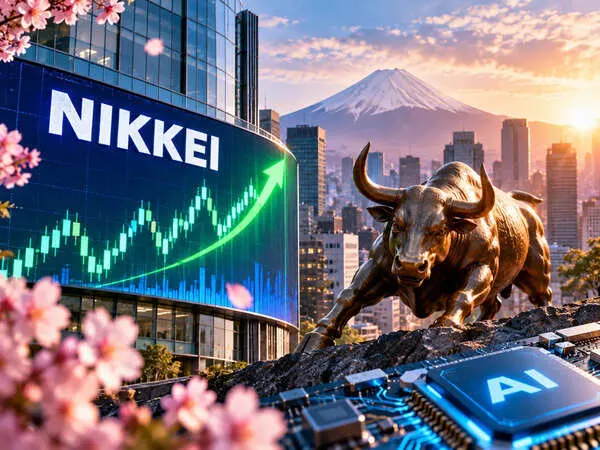
Asia's stock markets staged their strongest session in weeks on Monday, clawing back, on Monday morning, the chunk of last week's rout as the fear that the AI-trade unwind had become systemic receded: the MSCI index of Asia-Pacific shares ex-Japan rose nearly 2 per cent after a 4.6 per cent weekly decline, with the region's exchange listings bouncing broadly from the week's panic lows.
The region's heavyweight markets led the recovery. Japan's Nikkei 225 rose 2.04 per cent at the open and roughly 3.5 per cent by midday to around 59,327 — a bounce worth more than 1,800 points against last Friday's 57,434.77 close, which itself had recorded a nearly 6 per cent collapse. The broader Topix added about 2.8 to 3.3 per cent, while in Korea the Kospi — despite an early wobble to a negative print — swung up more than 1.8 per cent to about 5,131 after its own 6.02 per cent Friday plunge.
Taiwan reclaims its position
Taiwan's Taiex was Monday's strongest major market, rebounding roughly 5 per cent from Friday's rout — and its bellwether TSMC led the recovery with a gain of about 5.6 per cent, the clearest sign that the world's most central AI-chip manufacturing franchise had retained its investment thesis through the panic. Tokyo Electron added about 3 per cent in Tokyo, confirming the semiconductor-equipment chain had shaken off the margin-call chaos that hounded it last week, while Shanghai's Composite gained 0.7 per cent and Hong Kong's Hang Seng held near 24,529 the whole session.
The exception underlined the nuance: Australia's ASX 200 fell between 0.2 and 0.4 per cent, bucking its region entirely as investors considered the path of the local economy's own AI-and-data-centre capex exposure. And the futures markets kept a lid on the recovery: US S&P 500 futures were little changed and Euro Stoxx 50 futures sat marginally lower by mid-morning Tokyo time, confirming the American side of the market — where the AI-trade volatility began last Thursday — had not yet fully committed to the bounce.
What is driving the calm-back
The proximate drivers stack into two kinds. The first is the American base: Friday's New York close had already stabilised the world's largest market — with the S&P 500 up 0.31 per cent to 7,376.86 and the Nasdaq up 1.09 per cent to 24,579.42, its first meaningful advance after four straight weekly losses — meaning Asia Monday was recovering from a bounce, not making one cold. VIX closed at 25.58 on Friday, 9.23 per cent softer at the week's end, and the Philadelphia Semiconductor index had already added 4.2 per cent with AMD up 11 per cent and Micron 5.12 per cent, finishing the session. The second is the regional catalyst: analysts cited the Middle East tension easing as a broader shock absorber — a relief factor for any investor who spent October pricing supply shocks into the market's risk budget. But the easing was asymmetrical: as one strategist put it, the AI landscape's underlying question — how much of the projection behind the sector's 2026-2027 buildout costs is actually confirmed by margins rather than by capex itself — remains unanswered, and the weekend's announcement that Nvidia now faces an independent board probe of its chief executive over allegations relating to intelligence outreach left that open question standing.
What this week decides about the unwind
The coming sessions remove the bounce's ambiguity. Markets will see the US October CPI print on Tuesday, the last inflation read before a December Federal Reserve meeting that futures price as a 76-per-cent chance of a rate hike; and the earnings calendar runs CoreWeave, SoftBank and Applied Materials — three of the most information-dense names in AI-infrastructure's ongoing chain — through the same window. Should those reports validate the capex-to-cash-flow story, the Monday rebound becomes a durable bottom; should they undercut it, Asian investors will know the last week's rout was a re-pricing event whose second act has only just begun.
Africa's exposure to the session runs through two dependent channels. Frontier-market equity positions — like the Nigerian Exchange's heavyweights that lost N3.52 trillion last week — have followed the global risk budget with extraordinary sensitivity this autumn, and any continuation of Friday's bounce improves the case for frontier allocations that have been paused through this wobble. Commodities also gain from the bounce: a world market that stabilises its capex cycle tends to stabilise its commodity import demand, which is precisely the earnings assumption on which Nigeria's 2027 budget and West Africa's cocoa forward orders sit.
The readings that say the unwind has not ended
Three things still separate Monday's bounce from a bottom: the American dollar, the volatility index and the credit market. The dollar index eased just 0.1 per cent to 102.22 on Monday morning after the strongest single-session gain in five months on Friday — a conditional rather than sustained strength that leaves the emerging markets' FX pressure unresolved. And the credit leg has barely participated in the rally, with US 10-year Treasuries and Bunds trading lower rather than tracking equities higher — a pattern that suggests institutional money has not returned to the AI-trade's risk budget but is using this week to reposition.
The bounce has bought the AI trade its Tuesday test. What it decides about the coming week — whether Monday's stability carries through with a genuine bid or gets sold into like the last three recovery attempts — will determine whether global markets spend the rest of November re-priced at a lower level of the AI-trade's capex promise or resume their run to the 2027 outlook targets.
Up next
Murban Crude Jumps 3% Above Brent as Physical Market Defies Paper Slump
Gulf physical benchmark climbed to $99.17, some $1.70 over Brent futures, even as crude slid toward $96 on Iran-talk optimism and a 1.4m b/d surplus forecast.
More in Markets
See all
Analysts See NGX Crossing N200 Trillion by December as Refinery Listing Looms
From N161.59 trillion after a losing week, capital-market analysts project a year-end push past N200 trillion on the Dangote Petroleum Refinery listing and returns above 57 per cent.

Profits Up, Prices Down: The NGX Sell-Off Just Made Some Blue Chips Genuinely Cheaper
Nine-month results covering roughly 90 per cent of the exchange’s value show names like MTN Nigeria earning 55 per cent more while costing less — and a screen for telling cheap from falling.

Gold Reclaims $4,100 as Central-Bank Buying Offsets a Hawkish Fed Path
Spot gold rallied 1.4 per cent to about $4,123 even with December hike odds near 76 per cent, as Q3 central-bank purchases of 321 tonnes anchor the floor.
About the author
Abiodun Abdullahi
Author / Business and Markets Writer
Abiodun Abdullahi writes for BusinessPress.


