Wall Street Logs Worst Week Since June as AI Selloff Deepens and Oil Jumps
A broad selloff in technology shares dragged the Nasdaq to its worst week since late June, while Brent crude surged on Middle East supply risks.
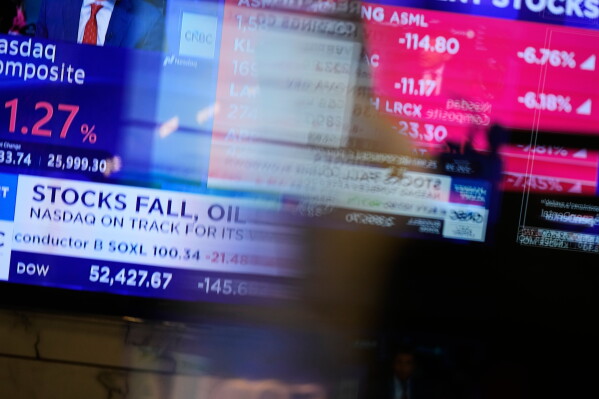
A broad selloff in technology and chip stocks pushed Wall Street to its worst week since late June, as investors reassessed the valuations underpinning the artificial-intelligence trade and rotated into healthcare, financials and smaller companies.
The Nasdaq Composite fell about 2.1% on Friday, according to the Associated Press, while the S&P 500 slipped 1.1% to 7,659.44 and the Dow Jones Industrial Average eased 0.34% to 52,002.41 in the session. The weekly loss was concentrated in the semiconductor and AI-linked names that had powered much of the year's rally.
The rotation underneath
Money moved out of chipmakers and into defensive and rate-sensitive sectors. Healthcare, financials and consumer discretionary names drew buyers, and the equal-weighted S&P 500 and small-cap Russell 2000 outpaced the headline benchmarks at points during the week, a sign that the weakness was concentrated rather than universal.
The shift followed a run of hotter-than-expected US inflation data. September producer prices rose 1.3% month on month, the largest increase since March 2022 and well above expectations, with energy a major contributor. Consumer inflation ran at 3.7% year on year. The readings kept alive bets that the Federal Reserve could raise rates again even as it prepares to meet on October 27 and 28.
Treasuries and the Fed
Despite the inflation surprises, Treasury yields fell sharply during the week as investors sought perceived safety. The benchmark 10-year yield dropped to around 5.09%, down from a peak above 5.30% earlier in October, its highest since 2002. The move suggested that fears about an AI-credit unwind and tighter financial conditions were competing with inflation risk.
Fed Chair Kevin Warsh, speaking in Bangkok, offered no signal on the rate path, saying he does not pre-judge meetings. Market pricing shifted over the week: odds of a hike in December rose from around 50% a month earlier to the range of 74% to 90%, depending on the measure, while traders largely expect a hold this month.
Oil's risk premium
Energy markets moved the other way. Brent crude jumped 3.7% to settle at $109.86 a barrel on Friday, with the Middle East conflict and disruptions around the Strait of Hormuz keeping a significant risk premium in prices. Attacks on shipping and the absence of a US-Iran deal have kept supply concerns elevated, and the International Energy Agency has been releasing emergency inventories to contain fuel prices.
Higher oil is a double-edged signal for markets: it supports energy equities but adds to inflation pressure and weighs on import-dependent economies, including Nigeria.
What to watch
The Fed's decision and guidance at the end of October are the next major catalyst, followed by the first estimate of third-quarter US GDP. Whether the AI selloff stabilizes or deepens, and whether oil holds above $105, will shape the risk appetite that has driven global markets this year.
Up next
FG Reports 4.39% Agriculture Growth, Targets Lower Food Prices
Nigeria's agriculture sector grew 4.39% in the second quarter of 2026, its strongest momentum since 2021, the Federal Government said at World Food Day.
More in Markets
See all
Oil Prices Slide as Geopolitical Risk Premium Eases, Weighing on Nigeria's Outlook
Brent slipped toward $104 and WTI to about $94 as supply-route fears eased, a move with direct consequences for Nigeria's budget and FX earnings.

Oil Climbs to $107 as Middle East Attacks Threaten Supply
Brent crude rose to about $107 a barrel as Middle East attacks threatened supply through the Strait of Hormuz, a windfall and a cost for Nigeria.
Analysts see muted Q3 earnings for oil majors
Softer crude prices and maintenance downtime are expected to weigh on results.
About the author
Kelechi Nwachukwu
Business Reporter
Kelechi Nwachukwu writes for BusinessPress.
More by Kelechi Nwachukwu