
Wami Agro Funding Targets 428,000 Ghana Farmers
Ghanaian agritech Wami Agro raises international funding to expand input credit, advisory and buyer links for smallholders, targeting 428,000 farmers by 2030.
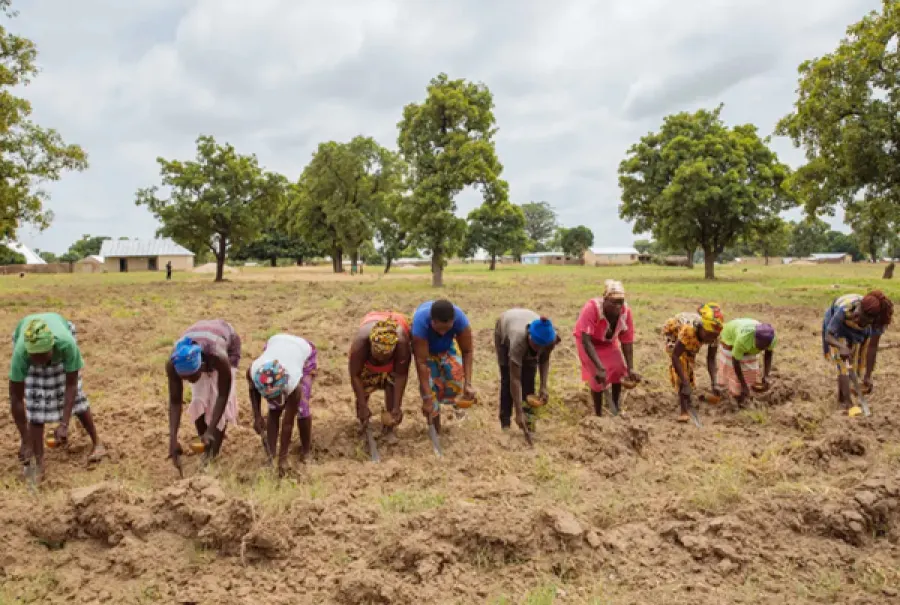
Ghanaian agribusiness Wami Agro has secured fresh investment from international investors to expand its smallholder-services platform, with a stated ambition to reach nearly 428,000 farmers by 2030, according to an announcement published November 6. The funding will strengthen the company's three-pronged model — farm inputs on credit, weather forecasting and agronomic advice, and connections to buyers — while increasing direct produce purchases from farmers across Ghana.
The raise lands in a moment of quiet acceleration for climate-smart agricultural finance in West Africa. Wami Agro's pitch is that the smallholder's constraint is not a single missing piece but a bundle: without credit, farmers underinvest in inputs; without agronomic information, they mis-time planting and treatment; and without buyer connections, they sell at distressed prices to middlemen. Solving all three at once is what distinguishes integrated platforms from pure lenders or simple marketplaces.
Why bundled services matter for farmer income
The bundled model addresses the arithmetic that has trapped smallholder productivity for decades. A Ghanaian maize or tomato farmer facing input-credit scarcity plants late and thinly, relies on guesswork about weather windows, and ultimately sells below market at farmgate because aggregation costs are prohibitive. An input on credit, an SMS-scheduled climate advisory, and a buyer matched before harvest each raise the yield-price envelope; together they change the economics of the farm enough to justify scaling.
Wami Agro's produce-purchase commitments are the piece most platforms skip. Buying crops directly, and paying promptly, is the step that turns credit access into realised income: without a buyer, financed inputs can generate harvests that rot at the roadside. The company's plan to increase purchases directly aligns its revenue model with farmer income outcomes — an incentive alignment that pure lenders lack.
The 428,000 target in context
Reaching 428,000 farmers by 2030 would position Wami Agro among West Africa's largest smallholder-integrated platforms. The number matters economically because Ghana — like Nigeria, Côte d'Ivoire and Senegal — suffers a structural yield gap on staple and cash crops that technology-mediated input and extension services can begin to close. Smallholders dominate production in Ghanaian agriculture, supplying the bulk of cocoa, cereals and vegetables, yet remaining largely outside formal credit and structured markets.
The international-investor composition of the round signals the shifting appetite. Twenty years into Africa's agritech experiment, capital has begun to favour platforms demonstrating unit economics around physical distribution rather than app downloads — a bar Wami Agro, which physically buys and moves produce, meets by construction. African agriculture remains one of the world's largest untapped production frontiers, with the continent importing an estimated $90 billion in staple food commodities annually, a recent IFC estimate that converts farm-level yield improvements into macro-relevant currency and inflation relief.
What it means for Ghana's food economy
For Ghana's economy, the relevance is direct. Food inflation has been a persistent driver of headline CPI across West Africa since 2021, and Ghana's own stabilisation programme has leaned on exchange-rate repair and fiscal consolidation. Raising domestic yields in staples lowers the import bill, strengthens the cedi's real purchasing power and reduces the transmission of global commodity prices into local food markets. Platforms that distribute inputs and guarantee purchase of output are, in effect, running a private-sector extension and price-stabilisation network the state budget could not fund at scale.
The model also compounds. As Wami Agro's farmer base grows, its data — on yields, input response, repayment behaviour and buyer demand — becomes the raw material for further credit expansion, precise insurance products and even warehouse-receipt finance. The investment's immediate output is services; its medium-term output is data infrastructure for agricultural finance, the layer that ultimately determines whether smallholder credit can scale beyond donor-funded pilots.
Risks in the physical agro-logisticsbusiness
The caution in the model is that produce purchasing is a working-capital-heavy, margin-thin business exposed to post-harvest losses, price swings and logistics failures. Platforms that guarantee purchase prices bear commodity-risk positions that must be hedged or passed through, and farmers default on input credit at higher rates when weather shocks hit. The 428,000-farmer target therefore depends less on app adoption than on operational discipline: buying well, storing well, hedging crop risk and converting repayment data into ever-cheaper credit.
Comparisons with peers underline the stakes. Kenyan agritech Farm to Feed, which also matches farmers to institutional buyers, reports cutting food loss by 81 per cent on participating farms so far and triple-digit annual revenue growth — evidence the model's economics can work, with company-reported figures pointing to the direction. Ghana's Wami Agro now carries the same test at larger scale.
Investor and policy read-through
For impact and commercial investors, Wami Agro's raise is another datapoint that African agricultural SMEs can attract growth capital when they combine digital rails with physical operations — the blended-finance pattern now standard at Africa's development finance institutions. For policymakers, the expansion supports Ghana's explicit goal of raising smallholder productivity; the private platform route delivers extension services, credit and market access at a fraction of the cost of legacy state programmes.
Whether the company reaches 428,000 farmers by 2030 will be reported in its own disclosures; what today's announcement already establishes is that West African agribusiness growth capital is flowing again, and that the region's food-price inflation fight is increasingly being waged by platforms that finance, advise and buy from farmers in the same closed loop.
Up next
HBM Nigeria Profit Rises 31% to N272bn
Former Lafarge Africa posts N272bn nine-month profit, up 31%, with net sales of N928bn and operating margin at a record 41% as expansions advance.
More in Agriculture
See allNigeria Pitches $30bn-a-Year Climate Finance Market for Smallholder Farmers
PICTT and YAPU Solutions proposed a classification and financing framework for adaptation lending, with experts calling for public guarantee envelopes, regional risk instruments and coverage beyond crops.
Bank of Agriculture Reports N450bn Programmes Reaching 500,000 Smallholder Farmers
Progress figures show 2.5 million bags of fertiliser supplied, N20 billion mobilised under the price floor and 1,500 tractors deployed across 23 states, while beneficiary counts reported elsewhere differ.

FAO Food Price Index Slips on Weaker Import Demand
The FAO Food Price Index falls to 133.9 in October from 135.6 as cereal, dairy and meat ease on soft import demand, though prices remain 5.9% above a year ago.
About the author
Amina Suleiman
Finance Correspondent
Amina Suleiman writes for BusinessPress.
More by Amina Suleiman


