
Cocoa Futures Stabilise Over Two-Year-High Inventories as Demand Wanes
London and New York bounced after one-month lows but a fourth straight weekly loss and 2.5-year-high exchange stocks keep the structural repricing intact.
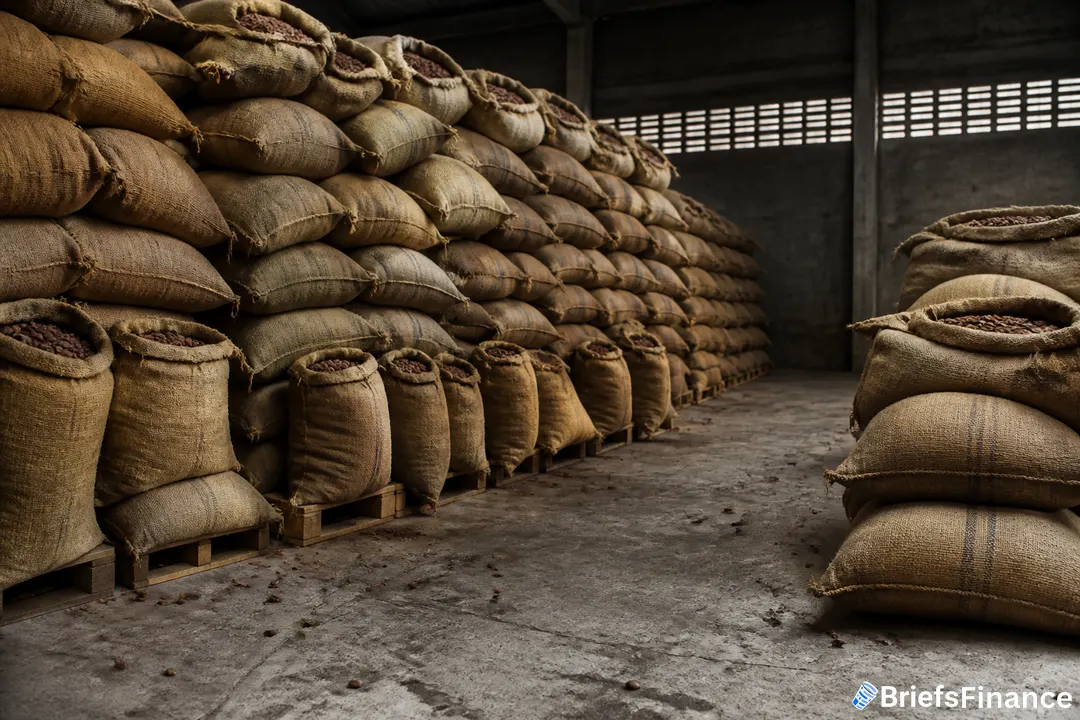
Cocoa futures staged a modest fightback on Friday after plumbing one-month lows, with London closing 1.8 per cent higher at £4,088 a tonne and New York gaining 1.6 per cent to $5,373 — but the relief bounce wrapped up a fourth consecutive weekly loss on a market whose exchange-monitored stocks have swollen to their highest level in more than two years and whose demand signal refuses to improve.
The stock overhang is the story underneath the price. Exchange-certified inventories in New York and London have accumulated to two-and-a-half-year highs, the by-product of back-to-back supply years under Côte d'Ivoire's production rope and a grind picture that has under-delivered. "Chocolate makers are blaming high cocoa prices for disappointing earnings and slow growth," one analyst noted in a summary of the market's current dynamics; a dealer quoted by Reuters said strong third-quarter grind numbers reflect restocking rather than underlying demand.
The supply scare the market won't buy
The irony is that the supply weather is arguably worsening. Commerzbank expects smaller 2026/27 crops in Côte d'Ivoire, Ghana and Ecuador thanks to a "strong El Niño pattern" now taking hold — conditions that historically tighten West African output through the harmattan season. Independent meteorological tracking by Maxar's Donald Keeney points to favourable conditions in Côte d'Ivoire itself but hotter, drier weather threatening harvest prospects in Ghana and Nigeria, the other two anchors of the Atlantic supply belt.
Yet the market treats the fear of shortage as noise and the evidence of demand weakness as signal. The decision makes commercial sense when you look at the price history: beans ran to record highs above $10,000 in 2024-2025, then spent 2026 grinding lower as the first real crops in years replenished inventories. Buyer behaviour has adjusted structurally — grinders reformulating, deferring contracts and negotiating for cheap positions rather than chasing physical cover — and every tonne that now enters warehouse stocks is a tonne the market no longer needs at panic prices.
The planning-price institutions have already repriced
The tell on where fundamentals are heading came last week when Barry Callebaut, the world's largest industrial chocolate maker, set its 2026/27 bean planning price at £4,000 a tonne on Nov 4 — roughly £164, or 3.9 per cent, below the prevailing London reference. Planning prices are the industry's published assumption for how much cocoa will cost through a season; setting them below market is the processor equivalent of guiding down the cost curve, and it tells farmers and traders alike that the demand side will not lift the physical bid to rescue a fading futures curve.
Côte d'Ivoire's farmgate move has already signalled the same direction: the 2026-27 season opened with the farmgate price cut to 1,200 CFA francs — about $2.10 — per kilogramme from the prior season's record. The collective effect is a deliberate income squeeze on Africa's producing households — Côte d'Ivoire and Ghana together grow over 60 per cent of world supply — designed to slow the pace of the farm-level cost bubble that has driven all the sector's pricing for two years.
Nigeria's cut of the repricing
Nigeria's domestic average cocoa price stood at about N971,480 per tonne across 37 tracked markets this week, still markedly above pre-boom levels but coming down from the peaks that drove the much-celebrated non-oil export surge of 2025-2026. The proportion of returns per tonne that farmers and traders keep is the fiscal question the season produces: with input costs, farm labour rates in key producing states like Ondo doubling, and the logistics through the ports already under pressure, a persisting global price at $5,200 per tonne would take Nigeria's second-leading non-oil FX earner down a peg even before any hand comes from Port-side nervousness.
For Nigeria's exporters and processors, the tactical implication is that buying forward against the 2026-27 season is a more defensible risk posture than riding physical inventories. With ICE stocks at 2.5-year highs, El Niño risks priced as a supply story that has already failed to rescue prices, and the demand signal continuing to soften, the cost of carrying cocoa in the hope of a spike is growing more expensive by the week.
What would flip the market higher
The price of the market's stubbornness will be tested through the harmattan window. A genuine supply shock — sustained dry-season stress across the Ghana belt, a mid-crop shortfall in Côte d'Ivoire beyond the 42-50 per cent mid-crop decline industry estimates already anticipate, or an El Niño acceleration through the dry season — would re-tighten the physical market and squeeze processors out of their suppressed-demand models. A stock drawdown continues through another round of restocking and the demand improvement that the mild monthly grind numbers would need to confirm would do the same.
Until one of those triggers lands, the bet the market is making — the one embodied in two-year-high stocks, £4,000 planning prices and falling farmgate rates — is that 2024-2025's price excess has to be unwound through 2026-2027 before the next structural bull can begin. That's the view investors should carry into the season whether they are watching cocoa from an African exporter's, a processor's or a trading floor's perspective, and it will remain the one in play until physical demand or weather forces it to be revised.
Up next
Dangote Concedes Refinery IPO Missed the 10-Million-Investor Target
Orders of about N6.4 trillion lifted the raise to a near-triple oversubscription, but retail participation was capped by access and know-how, the chairman said.
More in Agriculture
See all
Federal government pitches one-million-hectare tree crop expansion to European investors in Brussels
Nigeria has presented a plan to expand tree crop plantations by one million hectares to European investors in Brussels, positioning cocoa and other tree crops as an investment frontier while rehearsing compliance with the EU's deforestation regulation.
Fertiliser, Cocoa Lead Nigeria's Non-Oil Export Surge
Fertiliser has emerged as a top non-oil export earner alongside cocoa as Nigeria's industrial and agricultural shipments gain momentum in its diversification drive.
Sunbeth Capital Raises N150 Billion Commercial Paper to Finance Cocoa Value Chain
Sunbeth Capital is mobilising about N150 billion through commercial paper issuances to fund operations across Nigeria's cocoa value chain, targeting aggregation, processing support and export readiness.
About the author
Abena Ofori
Agribusiness Correspondent
Abena Ofori writes for BusinessPress.


