
Ivory Coast Mid-Crop Could Halve as Harmattan Threat Builds Across West Africa
Industry estimates put the 2026/27 mid-crop at 300,000-350,000 tonnes, down 42-50 per cent, even as prices hover near one-month lows on the demand freeze.
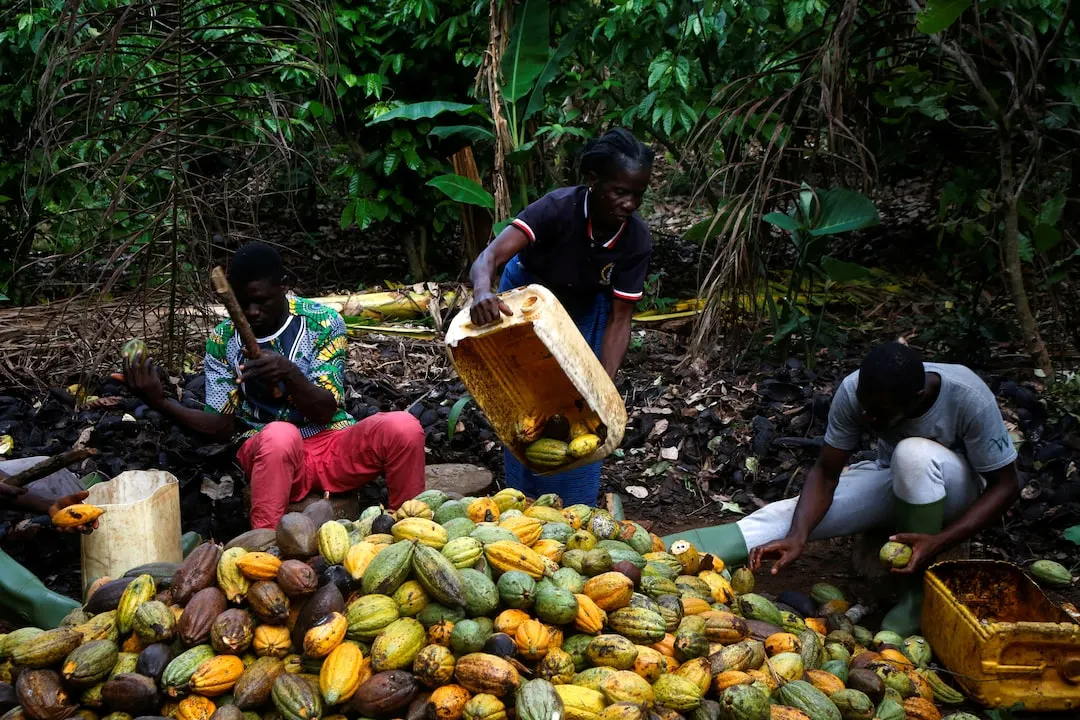
The world's next cocoa shortfall is no longer a forecast: industry estimates circulating through the trade press put Côte d'Ivoire's 2026/27 mid-crop at 300,000 to 350,000 tonnes, a fall of 42 to 50 per cent from a year earlier, as the same hot, dry conditions that gave the world the 2024-2025 price spike build across West Africa into the harmattan season. The market's reaction — New York cocoa near one-month lows at $5,119 a tonne and London just off its floor — captures the paradox precisely: supply is about to shrink while demand stays away.
The mid-crop is the season's second harvest, and its collapse means the export flow of the world's largest producer slows just as the December-to-January harmattan window opens. Meteorological tracking by Maxar's Donald Keeney, cited through the weekend's trade coverage, points to favourable conditions inside Côte d'Ivoire's growing regions but hotter, drier weather threatening harvest prospects in Ghana and Nigeria, extending the supply squeeze across the whole of the Atlantic forest belt.
The demand problem the supply shock cannot rescue
Normally a 42-to-50 per cent mid-crop collapse would send futures vertical. The reason it isn't is that the demand side is broken: certified exchange stocks in New York and London sit at two-and-a-half-year highs, the accumulated residue of two strong seasons of output hitting a grinding industry that has cut back on purchases as price levels reset consumers. "Chocolate makers are blaming high cocoa prices for disappointing earnings and slow growth," one market summary noted with the weekend's trade; a dealer told Reuters the strong third-quarter grind numbers reflect restocking rather than underlying consumption.
The industry's own planning prices have ratified the demand ceiling. Barry Callebaut set its 2026/27 bean planning price at £4,000 a tonne on Nov 4 — roughly £164, or 3.9 per cent, below the prevailing London reference and the sector's explicit signal that it will not bid up the physical market to secure supply. Côte d'Ivoire's own farmgate response has followed the same logic: the 2026/27 season opened at 1,200 CFA francs (about $2.10) per kilogramme, below the prior-season record, squeezing producer incomes exactly when input costs have been climbing.
Nigeria's window in the squeeze
Nigeria produces roughly 340,163 tonnes a year, fourth globally behind Côte d'Ivoire (about 2.2 million tonnes), Ghana and Indonesia, with Ondo state contributing about 30 per cent of the national crop. The mid-crop squeeze through late 2026 and early 2027 hits Nigeria's export calendar at the season when its tonnage would normally move through Lagos ports against contracts written on the prior July's benchmark prices — meaning exporters who locked forward positions on prices that have since slid 14-15 per cent face a rising margin gap between contract value and physical delivery cost.
The farm-gate arithmetic compounds the exposure. Daily labour rates in Ondo have doubled from N2,000-2,500 to N5,000-6,000, input costs have climbed, and rural insecurity has added a risk premium to planting cycles, according to the Cocoa and Plantain Farmers Association of Nigeria. Against a global price that remains historically elevated but is falling toward the £4,000/$5,200 demand-defending planning band, the Nigerian cocoa farmer's 2027 economics will depend on whether the frozen demand side thaws faster than the supply side recovers — a race neither side currently controls.
For Nigeria's fiscal position the sector's contribution — the second-biggest non-oil foreign-exchange earner — is what makes the squeeze a government problem, not merely a farmers' one: the cocoa export-led forecast behind the foreign reserve build-up, the CBN's non-oil receipt assumptions and the entire forward-currency planning cycle along with the rural employment base of the cocoa belt all scale off this season's export economics.
What would change the market's direction
Two tests will define the season. The harmattan itself — if December-to-January dry-season winds crack the main-crop's flower and pod structure across Ghana and Nigeria as predicted, the 2026/27 main crop's own output will compound the mid-crop's loss, tightening physical availability through mid-2027 and reopening the price upside the market has been progressively fading all year. The demand thaw is the other: any sign that grind volumes (the processing industry's real consumption) are stabilising — and any indication that chocolate makers are adding back cocoa butter and cocoa content to their formulations — would turn the currently frozen exchange stocks into bid support.
Until one of those tests resolves, the market's message is that 2024-2025's price excess must be unwound through 2026-2027 before the next structural bull phase begins. And if the weather beaten West African cocoa belt delivers more of the supply shock the meteorologists are already describing through the harmattan window, the market will have a hard time holding that view — and an even harder time keeping farm-gate prices anywhere near the levels that made the sector a fiscal story.
Up next
Robusta Nears 2.5-Year Low as Vietnam Crop Builds and Sugar Slides Under $500
London robusta traded at $3,232 after last week’s $3,140 floor while white sugar fell to $499 as cheap oil flips Brazilian mills back toward sweetener output.
More in Agriculture
See all
Federal government pitches one-million-hectare tree crop expansion to European investors in Brussels
Nigeria has presented a plan to expand tree crop plantations by one million hectares to European investors in Brussels, positioning cocoa and other tree crops as an investment frontier while rehearsing compliance with the EU's deforestation regulation.
Fertiliser, Cocoa Lead Nigeria's Non-Oil Export Surge
Fertiliser has emerged as a top non-oil export earner alongside cocoa as Nigeria's industrial and agricultural shipments gain momentum in its diversification drive.
Sunbeth Capital Raises N150 Billion Commercial Paper to Finance Cocoa Value Chain
Sunbeth Capital is mobilising about N150 billion through commercial paper issuances to fund operations across Nigeria's cocoa value chain, targeting aggregation, processing support and export readiness.
About the author
Abena Ofori
Agribusiness Correspondent
Abena Ofori writes for BusinessPress.
More by Abena Ofori


