
IMF Chief Tells Central Banks to Price an AI Slowdown as Markets Whipsaw
Kristalina Georgieva said any slowdown in AI-driven growth must be factored into policy, warning that volatility is likely to continue and complicate inflation fights.
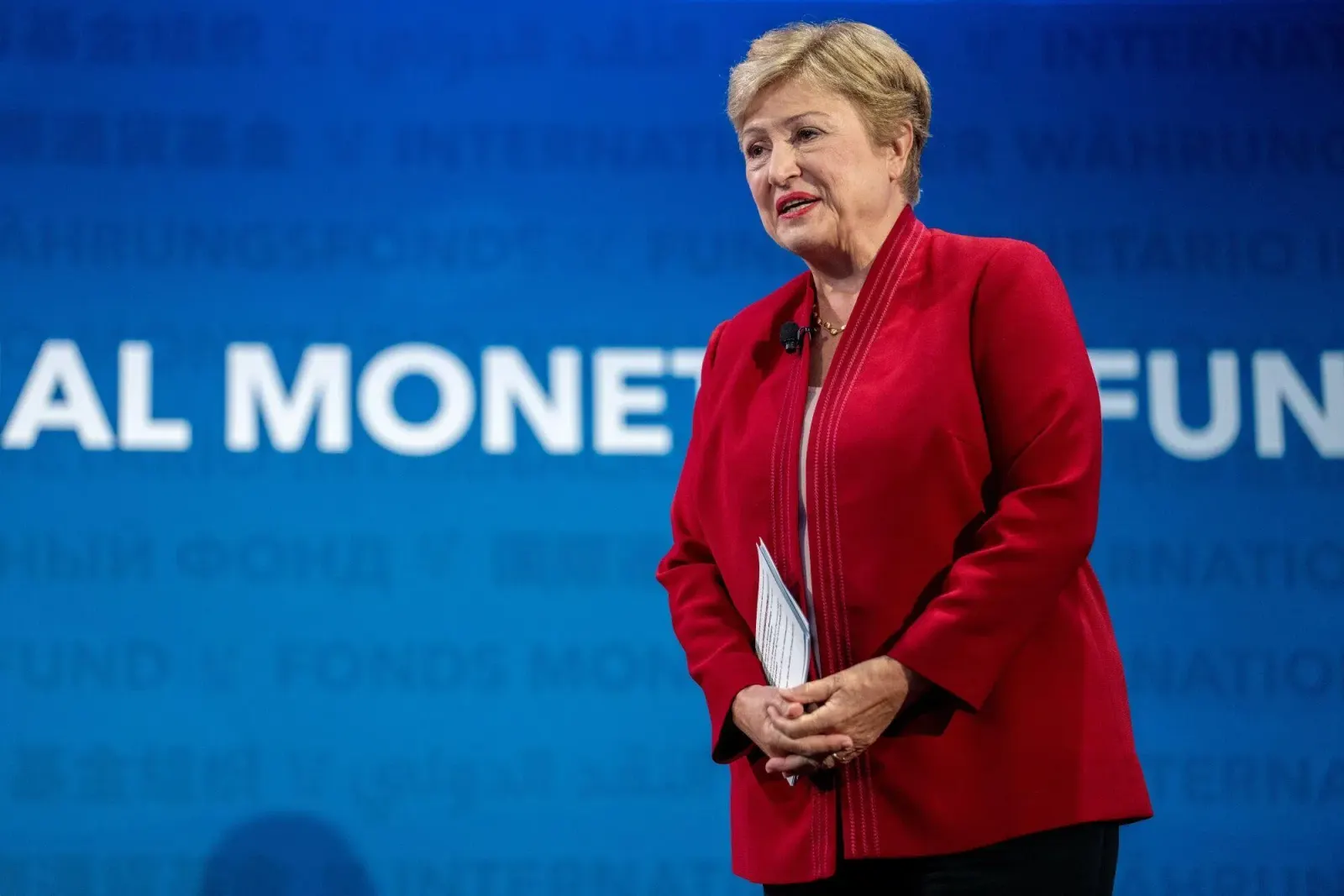
Central banks now have to price a possible slowdown of the AI-driven growth impulse into their rate decisions, the head of the International Monetary Fund said as this month's equity rout sent a fresh signal through global financial markets, turning a technology-cycle debate into a monetary-policy problem overnight.
"Should there be a slowdown in the AI-driven growth impulse, it would need to be factored in as central banks assess the necessary steps in the fight against stubborn inflation," IMF Managing Director Kristalina Georgieva told reporters on Friday at the fund's Washington headquarters, cautioning in the same breath that "things are going up and down, and this is likely to continue." The IMF has watched markets chop violently for weeks as AI-linked equities swung both up and down worldwide, complicating the price-stability picture for every major policy committee.
The new wobbling macro question: an AI impulse rather than a normal investment cycle
The IMF leadership is essentially arguing that today's AI investment boom behaves like a macroeconomic policy input rather than a sector story. Where a decade of technology capex flowed through equity valuations alone, the 2025-2026 buildout is large enough to move measured GDP, employment, electricity demand and industrial materials — which means a slowdown feeds discretionary estimates for both growth and inflation.
Georgieva's financial-stability warning is the sharper edge of this argument. The AI boom is lifting growth in some countries and offsetting the negative oil-supply shock coming out of the Middle East war, while simultaneously creating inflationary pressures and financial stability concerns. In the October IMFscenario analysis, a steep pullback in AI investment could cut global output by 1.1 per cent by 2028, and US output by 1.8 per cent — a shortfall central banks have no matching tool other than rate cuts that would themselves be reflationary.
The volatility premium now in every policy forecast
Central banks have survived sector booms before, including the dot-com era that gave the world its model of overinvestment followed by overcorrection. What is different in this cycle is the speed and breadth of repricing. Thursday's tech rout spilled into forced selling, margin calls for leveraged positions and spooked retail investors — the mechanics that convert asset-price shifts into money-supply episodes for money-centre central banks watching broad financial conditions.
That is why Georgieva's formulation is deliberately dual: monetary authorities must fight "stubborn inflation" while accounting for a growth vector that may decelerate. Both jobs in this cycle are confounded by identical data — capex spending surges both add to measured investment and to goods-demand inflation — and both will be judged by a market that moves faster than a quarterly forecast revision cycle can accommodate.
What it means for rate-setting
For the Federal Reserve and its peers, the hard and specific implication is that financial conditions have become a new channel of policy transmission — occasionally overriding the fundamentals that conventional policy was designed to move. A central bank easing for a cyclical slowdown risks leaning into an AI-driven asset inflation that its own rate path ignited; a central bank tightening into equity declines risks amplifying a revenue, employment and demand dip that the AI freeze then turns into a real economy hit.
The IMF's prescribed posture is therefore calibrated, not unilateral. Georgieva's warning lands within a data window marking the Fed, the Bank of England and the ECB on hold-to-tighten bias into winter, with US inflation prints proving sticky, the real question each committee faces being how to design and communicate a policy expectation in conditions where the underlying economy has a technology-cycle pacesetter whose turning points are determined in equity markets, not in demand surveys.
The emerging-market corollary
Emerging-market central banks — including those in Nigeria, Ghana, Kenya and Egypt — read the IMF's warning as a forward constraint on their own macro models. AI-infrastructure buildout has so far been concentrated in the United States, the Gulf states and the industrialized Asian countries, but the accompanying commodities cycle has already spread through semiconductor materials, rare-earth minerals and electricity inputs for data-centre development. A slowdown in the AI buildout therefore transmits backward through commodity markets, reinvestment flows and asset repositioning in ways frontier-market policymakers cannot ignore.
For currency markets, the specific risk priced since Friday is that AI-cycle volatility re-worries global investors about risk-on positioning relative to dollar liquidities — the pattern so far of 2026 term structure and the IMF's own October warning that a wide range of scenarios is plausible. This is the precise window Georgieva has flagged: monetary authorities everywhere, including the frontier, are working out how hard to lean against the marginal card of AI-cycle uncertainty as they plan their next step.
The IMF leadership's message, in effect, is that the world's monetary framework is being stress-tested against growth sourced from a sector it cannot directly measure or steer. The 2027 forecast cycles will be built around for this challenge. The direction matters first, however: whichever way the AI cycle rolls through year-end, the days of treating technology investment as a sector footnote in global policy formulations are over.
Up next
NGX Investors Lose N3.52 Trillion in Five-Day Retreat
The All-Share Index fell 2.13 per cent for the week as turnover collapsed 63 per cent; Honeywell gained 30.82 per cent while oil and industrials led the slide.
More in Economy
See allNigeria's Inflation Eases to 14.63% in September as Food Prices Fall
The NBS said headline inflation dropped to 14.63% in September from 15.39% in August, with month-on-month food prices falling 1.55% and core inflation at 12.95% year-on-year.
IMF Sees Sub-Saharan Africa Growing 4.5% in 2026 as Aid Flows Shrink
The IMF's October Regional Economic Outlook upgraded Sub-Saharan Africa's 2026 growth forecast to 4.5% while warning that bilateral aid will fall another 12% after dropping about a quarter in 2025.
Nigeria Unveils $78.5 Billion, 65-Project Investment Pipeline at IMF-World Bank Meetings
Nigeria has unveiled a pipeline of 65 investment projects requiring a combined $78.5 billion in capital, pitched to global investors at the IMF and World Bank Annual Meetings in Bangkok.
About the author
Abiodun Abdullahi
Author / Business and Markets Writer
Abiodun Abdullahi writes for BusinessPress.


