
Kospi Triggers Sidecar as Chip Rout Hits Seoul
South Korea Kospi plunged more than 5 percent and temporarily halted program trading as the global AI chip rout reached Seoul.
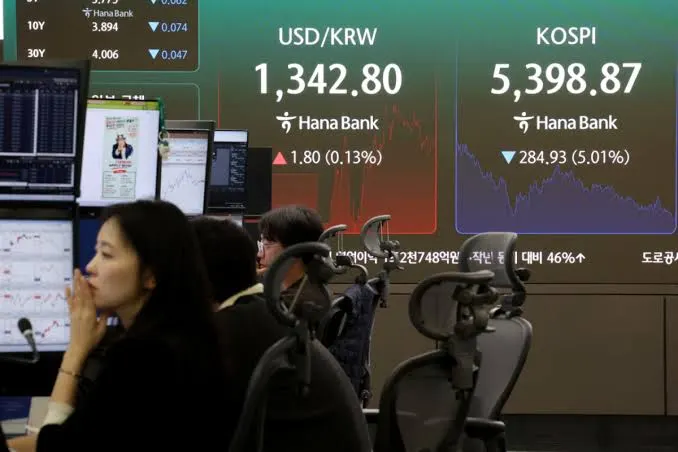
Asia's chip core buckled on Thursday as a global AI-share sell-off reached South Korea's exchange with full force, driving the Kospi down more than 5 per cent to near seven-month lows and briefly triggering the exchange's emergency circuit-breaker against program selling.
South Korea's benchmark Kospi index tumbled as much as 5 to 6 per cent in a single morning, according to exchange and wire-service accounts, forcing regulators to trigger a sidecar mechanism — a five-minute suspension of program trading designed to slow the descent — as sell orders overwhelmed the market. The junior Kosdaq index fell more than 4 per cent in sympathy, while Tokyo also gave up ground with the Nikkei shedding 1.8 to 2 per cent in a session where broad-market strength was, once again, masked by the technology sector's collapse.
Memory chips took the plunge directly
Damage concentrated in exactly the names that had carried the AI trade for months. SK Hynix, the world's dominant supplier of high-bandwidth memory used in advanced AI accelerators, lost between 7 and 9 per cent despite having reported buoyant results in recent weeks, while Samsung Electronics fell 5.5 to 6.7 per cent. In Tokyo, Kioxia — the memory specialist that listed this year — dived more than 13 per cent, and equipment suppliers Advantest and Tokyo Electron lost as much as 14.7 and 9 per cent respectively. SoftBank, whose investment story is entangled with AI speculation through its Armholding and Vision Fund exposure, slid almost 7 per cent.
The proximate cause lay in the overnight United States session, where Qualcomm and Arm Holdings delivered results that were respectable but insufficient to justify the sector's valuation premium, and where Nvidia had already shed significant ground the day before. Seoul is the poster child of the AI-led surge from the first half of the year: the Kospi outperformed almost every index globally through June before correction caught up with it this month, so the market's fall is not new — but Thursday's size, and the sidecar trigger, made it the sharpest single-day step-down since the summer correction began.
Why Korea sits at the centre of the AI trade
The concentration is structural. South Korea's index is weighted heavily toward precisely the two conglomerates — SK Hynix and Samsung Electronics — that supply the high-bandwidth memory and foundry capacity the global AI buildout consumes, so global sentiment about data-centre capital spending drives Korean markets essentially through a single channel. When American investors mark down the durable future of AI infrastructure, Korea's largest listed companies absorb the repricing instantly, with none of the domestically-anchored consumer or industrial buffer than dilutes the exposure in other large markets.
That channel operates on export orders as well as share prices. Korean memory makers generate most of their revenue from American hyperscaler families, which means Congress's scrutiny of data-centre construction — the campaign promise that newly elected Democratic lawmakers in Texas and Georgia won on — translates directly into Seoul-listed procurement expectations. Analysts also note that the sidecar mechanism, which halts program trading only briefly, was introduced precisely because of episodes like 2020 and 2024; its invocation on Thursday shows how deep the momentum unwind goes.
The rotation broadens as AI compresses
The wider regional tape told the counter-story, which is why Thursday was not a pure risk-off day. Toyota and Honda each gained around 5 per cent on reports of strong quarterly results and expectations that a new Washington would soften tariff aggression, lifting the Topix by 1.4 per cent despite the tech slide. Hong Kong rally conductors gained almost 3.6 per cent on hopes of a US-China truce, with Tencent, Alibaba and JD.com leading, and Hyundai Motor added on the tariff logic. Seoul remained the biggest loser precisely because its market is the most AI-leveraged large index in the world's most AI-leveraged trade.
Currency and rate markets absorbed the challenge more calmly than equity ranked. The won weakened modestly through the morning, the yen tracked dollar moves, and South Korean rate markets focused instead on policy questions unrelated to the equity move. Taiwanese indexes fell more than 3 per cent under pressure from their own semiconductor complex, showing that the dominance of a handful of global AI-related supply-chain names is no longer merely a US phenomenon.
Sizing the spillover risk
The central question for the rest of the week is whether the American investment story will hold up at Friday's payrolls data, which the market will read both as a macro signal and as a test of whether the AI-capex cycle can continue untouched. Korean authorities also face the calendar problem that makes the rout more corrosive: with a rate cut cycle already debated at the Bank of Korea and three-month YTD gains evaporating faster than they can be replaced, a program-trading halt that fires repeatedly would underscore the market's structural fragility.
For Africa's emerging markets community, the Korean episode is a distilled warning. The same concentration that drove the Kospi — a handful of beneficiaries absorbing most of a global investment theme — exists in Buenos Aires-sized pockets of the AI-linked global economy, and every market that has ridden one trade too far is now discovering that the exit is narrower than the entrance. When Korea's largest companies have to fund their next fab and their next memory-generation investment, Thursday's single-day 5 per cent repricing will transmit first to their capital-spending plans, and then to the Korean index's revenue forecasts for the entire exchange.
Up next
Brent Crude Slides Below 100 Dollars on Ceasefire Bets
Brent crude dropped below 100 dollars for the first time in two months as investors bet post-midterm politics will end the Iran war premium.
More in Markets
See all
NGX Investors Lose N3.28tn as Dangote Cement Tumbles
The NGX sheds N3.28 trillion in one session as Dangote Cement falls 10 per cent, erasing about N2.5 trillion of value while the index stays up 60% for 2026.

FTSE Stages Fightback After Worst Day Since March
The FTSE 100 falls 2.35% intraday to 10,528 before closing down 1% as Europe absorbs the global AI rout, with insurers and miners leading declines.
Gold Slides as US Jobs Jolt Lifts the Dollar
Gold drops as much as $66 an intraday session as the surprise US jobs report lifts the dollar and cools Fed rate-cut bets, reversing its week-long haven bid.
About the author
Kwame Mensah
Markets Correspondent
Kwame Mensah writes for BusinessPress.
More by Kwame Mensah


