
Nigeria, China Sign $30m Deal on Grassroots Development Projects
Nigeria and China signed a $30 million agreement funding community-level infrastructure and livelihoods projects outside the mega-project era.
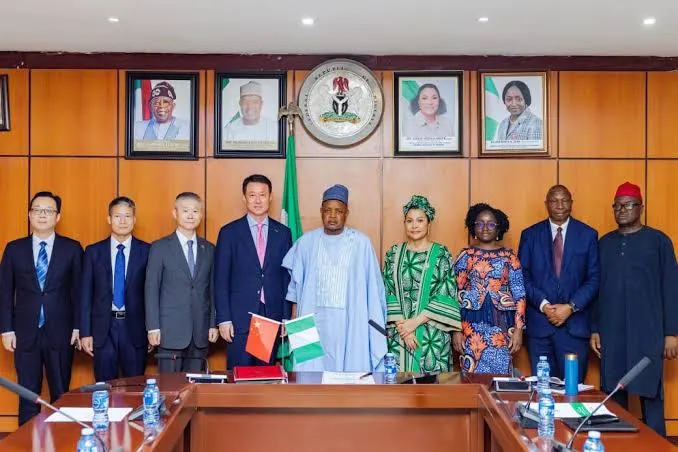
Nigeria and China have signed a $30 million agreement to fund grassroots development projects — a modest headline number with disproportionate diplomatic and delivery significance. The deal, signed this week and reported across Nigerian outlets, is structured for community-level infrastructure and livelihoods rather than the large-ticket infrastructure that has defined China-Nigeria financing for two decades.
The structural story is in the shift. The model of China-Nigeria economic engagement is changing: from the mega-project era of railways, ports and dams financed through concessional sovereign loans, toward smaller, faster cycles of grant and mixed financing that fund water systems, market facilities, schools, clinics and micro-enterprise at local government level. A $30 million grant is a rounding error against the bilateral trade relationship, but as policy it is the mechanism that puts money where the poverty map is denser — and where large projects never reach.
Why grassroots funding matters in Nigeria's fiscal arithmetic
Nigeria's development-finance gap at the community level has widened through years of fiscal stress. Local governments — the tier constitutionally responsible for primary services — have been chronically underfunded and financially mismanaged, leaving markets, rural roads, boreholes and primary health centres to decay or fall to community self-help. State budgets concentrate on salaries and overheads; federal capital projects stop at state capitals; donor projects target technical assistance or health-system verticals. Grassroots capital expenditure is the layer of Nigerian public finance with the least reliable funding — which is why a $30 million grassroots facility, arriving outside the normal appropriations channel, can actually change what gets built in communities this year.
The delivery question is what has always undone such facilities. Nigerian grassroots projects fail at procurement, contracting and maintenance more than at conception — and the governance architecture around this facility (who selects projects, who contracts, who audits, who maintains) will matter far more than the headline amount. The credible model is one where state and community structures are bound into transparent implementation with publication of what is built, where, and at what cost.
The strategic layer: Nigeria's partner portfolio
The grant also lands inside a broader competition for Nigeria's partnership portfolio. China has been recalibrating its Africa financing toward smaller, richer-yield engagements since its Belt-and-Road lending peaked and the continent's debt distress forced a rethink; grants and mixed credits for livelihoods projects now sit alongside the carry-over infrastructure pipeline. Western partners have responded with their own instruments — the World Bank's record IDA allocations, EU Global Gateway financing, US development-finance re-engagement. Nigeria is increasingly in the position of managing a competitive multi-partner portfolio, converting geopolitical attention into financed projects rather than choosing sides.
For the bilateral trade relationship — China is Nigeria's largest single trading partner, with imports dominated by manufactures and exports weighted to minerals and agriculture — grassroots facilities also serve a reputational function: they balance the trade story, which Nigerian public opinion reads as overwhelmingly one-sided, with visible community benefit. Every completed borehole or market stall funded by a bilateral partner buys goodwill that balances the trade deficit's political cost.
What to watch in the delivery
Three markers will separate the headline from the outcome. First, deployment speed: whether projects are identified and contracted within the fiscal year the grant is announced. Second, visibility: whether project lists, locations and costs are published for community verification, which is the single cheapest anti-corruption technology. Third, maintenance: whether facilities are handed to operating responsibility with budget lines, or left to decay in the now-familiar pattern of completed-but-abandoned local projects.
Nigeria's grassroots infrastructure backlog is measured in thousands of projects per state. A $30 million facility funds a fraction of one percent of that need — but if it delivers visibly and cleanly, it becomes a template for the medium-size, community-level facilities that should become the default of Nigeria's partner financing. As a headline, it is small. As a delivery test, it is exactly the right size.
Up next
Pivot Raises N100.08bn From Oversubscribed Commercial Paper Issuance
Pivot raised N100.08bn from an oversubscribed commercial paper issuance, a landmark scale for Nigeria's N1.61trn corporate CP market.
More in Economy
See allNigeria Unveils $78.5 Billion, 65-Project Investment Pipeline at IMF-World Bank Meetings
Nigeria has unveiled a pipeline of 65 investment projects requiring a combined $78.5 billion in capital, pitched to global investors at the IMF and World Bank Annual Meetings in Bangkok.

Nigeria Inflation Extends Three-Month Slowdown To 15.39 Percent
Nigeria's headline inflation has fallen for a third consecutive month to 15.39 percent, extending a disinflation run ahead of the November 24 MPC meeting.

Bank of Industry Eyes N3trn Recapitalisation as Federal Government Unveils National Industrialisation Plan
FG plans about N3trn in Bank of Industry capital by 2026 under a new National Industrialisation Plan targeting 25% renewable energy in industry by 2030.
About the author
Tunde Balogun
Economics Correspondent
Tunde Balogun writes for BusinessPress.
More by Tunde Balogun


