FG finalises 2026–2030 development plan with $1 trillion economy target
The new five-year plan prioritises infrastructure, human capital and manufacturing, but its credibility depends on financing and execution.
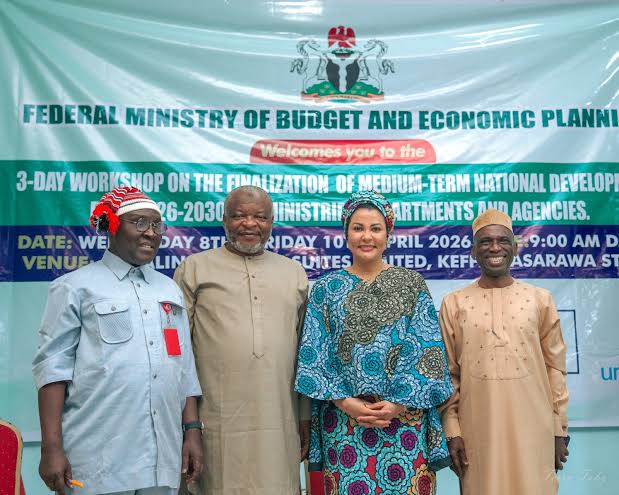
The federal government has finalised the 2026–2030 National Development Plan, a five-year framework intended to accelerate growth and put Nigeria on a path to a $1 trillion economy. The plan sets priorities for infrastructure, human capital, agriculture, manufacturing and the business environment.
Nigeria has produced many development plans. The challenge has always been implementation. Successive governments have announced ambitious targets, only to see them undermined by funding gaps, policy inconsistency and weak institutional capacity.
The new plan arrives at a difficult moment. Inflation is high, the naira is volatile, and fiscal space is constrained by debt service. Businesses are cautious about investment, and households are struggling with the cost of living. A credible plan must address those immediate pressures while laying a foundation for long-term growth.
What the plan prioritises
The framework focuses on the drivers of productivity: power, transport, education, health and access to finance. It also emphasises agriculture and manufacturing as sources of jobs and foreign exchange. Those are sensible priorities for a country that imports too much and exports too little.
Infrastructure is central. Poor roads, unreliable electricity and expensive logistics raise the cost of doing business and discourage investment. The plan aims to close those gaps through public spending and private participation.
Human capital is another pillar. Nigeria’s young population is an asset, but only if it is educated, healthy and skilled. Investments in education and health take time to pay off, which makes them easy to cut when budgets are tight.
The financing question
A plan without money is a wish list. The government will need to mobilise domestic revenue, attract private investment and use public resources more efficiently. Tax reform, subsidy removal and debt management are all part of the equation.
Nigeria’s tax-to-GDP ratio is low by international standards. Expanding the tax base without stifling growth is difficult, particularly when many businesses operate informally. The government must improve compliance, reduce leakages and build trust that taxes are being used well.
Private capital will be essential. The public sector cannot fund the entire infrastructure gap. Public-private partnerships can help, but they require clear rules, bankable projects and reliable dispute resolution. Investors need confidence that contracts will be honoured.
The implementation risk
Implementation is where plans usually fail. Coordination between federal and state governments is weak, procurement is often opaque, and projects are sometimes chosen for political rather than economic reasons. A plan that ignores those realities will not deliver.
The government needs a clear delivery unit with authority to track progress, resolve bottlenecks and hold agencies accountable. It also needs reliable data to measure outcomes. Without measurement, failure can go unnoticed until it is too late.
Policy consistency is equally important. Businesses delay investment when rules change unexpectedly. A stable macroeconomic framework, predictable trade policy and transparent regulation are as important as any specific project.
What it means for business
For companies, the plan signals where the government intends to direct spending and policy support. Infrastructure, agriculture, manufacturing and digital services are likely to receive attention. Firms that can align with those priorities may find opportunities.
But businesses should not base investment decisions on plan documents alone. They need to see budget allocations, procurement timelines and actual implementation. A plan is a signal, not a guarantee of demand.
Investors will also watch the fiscal arithmetic. If the government tries to do too much without raising revenue, it may borrow more, pushing up interest rates and crowding out private investment. The plan’s credibility depends on realistic financing assumptions.
The outlook
The $1 trillion target is a useful aspiration, but it is not a strategy. What matters is the growth rate, the composition of output and whether the benefits are widely shared. A larger economy that leaves millions behind is not a success.
Nigeria has the resources, population and entrepreneurial energy to grow faster. What it lacks is consistent execution. The new plan will be judged not by its ambitions but by whether it changes the lives of ordinary Nigerians.
The next five years will be decisive. If the government can deliver visible progress on power, roads, education and security, it will build confidence and attract investment. If the plan becomes another document on a shelf, the opportunity will be lost.
Up next
Lagos-Calabar Coastal Highway targets three-year completion, Umahi says
The coastal highway could cut logistics costs and open new corridors, but financing, land disputes and delivery risks cloud the timeline.
More in Economy
See all
IMF Urges Nigeria to Raise Spending Quality and Revenue as Growth Forecast Brightens
The IMF says Nigeria's improving growth outlook is not easing poverty fast enough, pressing for better-targeted spending and a broader revenue base.
Nigeria Unveils $78.5 Billion, 65-Project Investment Pipeline at IMF-World Bank Meetings
Nigeria has unveiled a pipeline of 65 investment projects requiring a combined $78.5 billion in capital, pitched to global investors at the IMF and World Bank Annual Meetings in Bangkok.

Nigeria's Foreign Direct Investment Plunges 92% to $11 Million in September
Nigeria's foreign direct investment fell 92% month-on-month to $11 million in September, highlighting the gap between hot portfolio money and long-term capital commitments.
About the author
Tunde Balogun
Economics Correspondent
Tunde Balogun writes for BusinessPress.
More by Tunde Balogun
Jollof rice now takes 37% of minimum wage as food inflation bites
Economy39 mins ago
Petrol imports fall 30% as Nigeria’s daily demand hits 44.4 million litres
Economy1 hr ago
NEC approves 90-day plan to cut food costs and ease living crisis
Agriculture3 hrs ago