FGN bonds, Eurobonds rally as Treasury bill yields edge higher
FGN bond and Eurobond yields fell modestly while Treasury bill yields rose, leaving Nigeria's fixed-income market mixed as liquidity stayed ample.
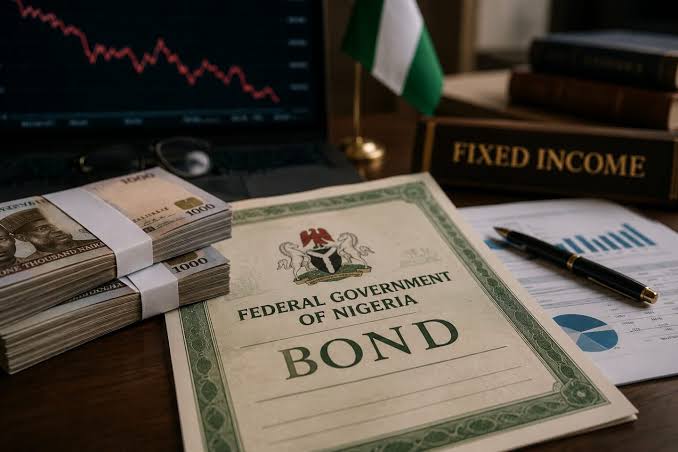
Nigeria’s fixed-income market delivered a mixed session on Wednesday, with Federal Government bonds and Eurobonds recording modest yield declines while Treasury bills came under mild selling pressure, according to a market report published on October 22.
The average yield on FGN bonds fell four basis points to 16.39 per cent from 16.42 per cent in the previous session. Nigerian Treasury bills ended their recent bullish run, with the average yield rising one basis point to 17.81 per cent from 17.80 per cent. Eurobond yields eased one basis point to 7.47 per cent from 7.48 per cent.
The money market moved in the opposite direction. Banking-system liquidity remained positive at N7.26 trillion, but the overnight rate rose four basis points to 20.34 per cent. The Open Repo Rate and the Nigerian Overnight Financing Rate were unchanged at 20.00 per cent.
A modest rally, not a turning point
The bond market’s gain was small enough to be described as a stabilisation rather than a rally. Yields had risen sharply in the prior sessions, driven by heavy government borrowing and a reassessment of the interest-rate outlook. The four-basis-point decline suggests that some buyers were willing to step in, but it does not signal a decisive change in direction.
The Treasury bill market told a different story. After a period of strong demand, investors sold short-dated paper, pushing the average yield slightly higher. The move was marginal, but it ended a bullish streak that had been supported by expectations of lower policy rates and ample liquidity.
Eurobonds followed global risk sentiment rather than domestic developments. A one-basis-point decline in average yield is within normal daily noise, but it indicates that Nigeria’s external debt continues to trade in line with emerging-market peers.
Why the curve is under pressure
The deeper story is supply. The Debt Management Office has been issuing large volumes of FGN bonds to finance the budget deficit. At the October 19 auction, it allotted N1.22 trillion through competitive bids and N800 billion through non-competitive sales, bringing total allotments to N2.02 trillion. Stop rates rose by up to 50 basis points on the longer-dated bonds.
That auction followed a sharp increase in the 10-year yield, which rose 46 basis points to 17.05 per cent in the week ended October 16. Nigeria was the only market among seven tracked by the Financial Markets Dealers Association to record a rise in its 10-year yield that week.
The DMO is willing to pay higher rates to secure funding. Investors are demanding compensation for inflation, currency risk and the possibility of further issuance. The result is a market where yields can rise even when banking-system liquidity is abundant, because the supply of new bonds is outpacing demand at the prevailing price.
Liquidity is not the same as appetite
Banking-system liquidity stood at N7.26 trillion, a large pool of naira looking for a home. In theory, that should push yields lower. In practice, banks and asset managers are cautious. They are managing duration risk, preserving capital and keeping powder dry for upcoming auctions and corporate earnings.
The Central Bank of Nigeria has also been active in open market operations. It offered N2 trillion in OMO bills on October 22, following a N2.41 trillion repayment on October 13 that had boosted liquidity. The OMO auction is designed to absorb some of that cash, but its final allotment will determine how much liquidity is actually withdrawn.
For investors, the competition between OMO bills, Treasury bills and FGN bonds is central. OMO bills offer short tenors and attractive yields, while FGN bonds offer longer duration and the possibility of capital gains if yields fall. Treasury bills sit in between. The relative value of each instrument depends on the investor’s liability profile and view on interest rates.
The inflation test
Headline inflation stood at 14.63 per cent in September, down from 15.39 per cent in August. That is a meaningful improvement, but it is still high relative to the yields on short-dated securities. The one-year Treasury bill stop rate was 15.90 per cent at the October 14 auction, implying a modest real return before taxes and fees.
For pension funds and insurance companies, those real returns are acceptable if they expect inflation to continue falling. For foreign investors, the calculation also includes expected naira depreciation. A 17 per cent naira yield can look attractive in dollar terms if the currency is stable, but it can quickly turn into a loss if the naira weakens.
The central bank’s decision to cut the monetary policy rate by 350 basis points to 23 per cent in September was intended to signal a shift toward easing. But the cash reserve requirement remains at 45 per cent, and liquidity management remains tight. The market is therefore pricing a slower easing cycle than the policy rate alone would suggest.
What to watch
The next round of government auctions will be the key test. The DMO’s fourth-quarter calendar includes large bond auctions in November and December. If demand remains weak, stop rates could rise further, increasing the government’s borrowing costs and putting pressure on the budget.
Investors will also watch the CBN’s OMO allotments and the overnight rate. A sharp rise in the overnight rate would signal that liquidity is tightening, which could support the naira but weigh on bonds. A decline would suggest that the central bank is comfortable with easier conditions.
For now, the market is in a holding pattern. Bonds are stabilising, Treasury bills are consolidating and Eurobonds are tracking global sentiment. The absence of a clear direction reflects genuine uncertainty about inflation, fiscal policy and the pace of monetary easing. Until those uncertainties resolve, large directional bets are likely to remain limited.
[irp] [irp] [irp] [irp] [irp]
Up next
Cardoso courts Chinese investment in naira assets after ICBC talks
CBN Governor Olayemi Cardoso has urged Chinese financial institutions to invest in naira-denominated instruments after meetings with ICBC in Beijing.
More in Markets
See all
Naira holds at N1,497 per euro as French debt stress weighs on currency
The naira traded at N1,497 per euro, falling below N1,500 for the first time since April 2024, as French bond stress weakened the euro rather than reflecting a domestic naira rally.
Nigeria revives NNPC, NLNG listing plan in push for N750trn market
Vice-President Kashim Shettima has revived plans to list NNPC and NLNG as part of a ten-year strategy to grow Nigeria's equity market to N750 trillion by 2036.
NGX slips 0.05% as market capitalisation falls to N159.07trn
Nigeria's All-Share Index fell 0.05 per cent to 244,989.9 points on October 22 as market capitalisation slipped to N159.07 trillion, with more stocks declining than advancing.
About the author
Kwame Mensah
Markets Correspondent
Kwame Mensah writes for BusinessPress.