
Dangote Refinery Petrol Exports Surpass Nigeria’s Daily Consumption
NMDPRA data show 54.63 million litres a day exported in September, up 37.3 per cent and above the 44.4 million litres of average domestic consumption.
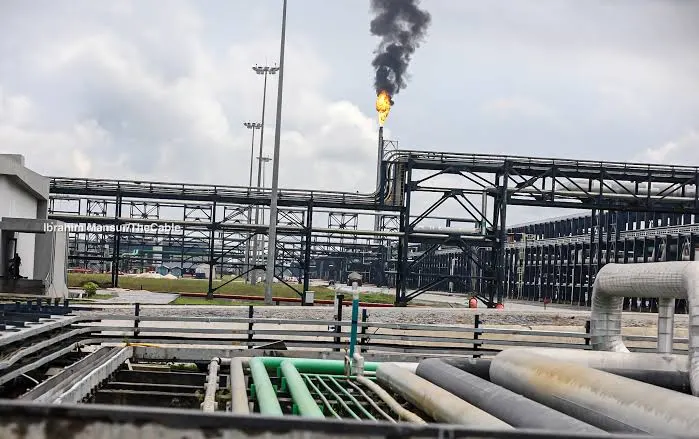
Dangote Petroleum Refinery exported 54.63 million litres of petrol a day in September, up 37.3 per cent month-on-month, surpassing the average daily domestic petrol consumption of 44.4 million litres, according to NMDPRA data reported by THISDAY — the moment the world's largest single-train refinery becomes a net exporter of the commodity Nigeria previously imported at its annual cost.
The milestone, achieved barely a year after the plant began steady production, changes the arithmetic of Nigeria's fuel economy in several directions at once. Dangote's petrol dispatches now serve a regional market — West African import-dependent economies that previously sourced cargoes through the same transatlantic stream Nigeria drew from — while the plant's domestic sales run through a different channel entirely, the NMDPRA's own September data showing the domestic leg carrying the majority of the listed volumes.
What the number means for the trade balance
Nigeria's petrol imports have been a five-decade fixture of the foreign-exchange ledger — the country historically spent more than $10 billion a year replacing a value its own crude could have produced domestically. The September export data does not yet mean the import line has reached zero: private importers still bring cargoes, and the NNPC's own supply columns run through the same ledger. But the 54.63 million litres a day of outbound product marks the direction — Nigeria is now, on NMDPRA's own numbers, selling more petrol to West Africa than it consumes — a reversal in a line item that has been exclusively negative since the 1970s.
For the currency account, the transmission runs through both sides. The import-bill compression that the refinery's ramp has produced all year is the visible half; the export leg now adds a new line, with Dangote's product disposals earning foreign exchange directly and through the West African fuel-cargo settlement stream the same way the country's crude exports do. For a 2027 budget framed around the same oil-and-gas revenue base that has underwritten every Nigerian fiscal plan since the 2000s, the shift from one export line (crude) to two (crude plus refined product) is the structural event that moves nothing in the headline but years of the ledger beneath it.
The price-control problem that remains
The export milestone does not settle the domestic price problem, and the N130-a-litre gantry price rise the refinery announced last week (to N1,300) has already entered the consumer-cost debate. The export configuration creates new options: the refinery can arbitrage its domestic sales against regional buyers now that its output outstrips Nigerian demand, and the retail price debate — between consumer-protection advocates and the freer market the refinery's economics require — effectively becomes a policy-discipline question for NMDPRA's pricing supervision rather than a supply question.
The competition question sharpened too this week: the Nigerian National Petroleum Company's own retail dispensation and importing arm continues to operate in the same market, and the recent petrol price data showing NNPC-affiliated stations at around N1,360 a litre versus Dangote's N1,300 distribution sets a public price spread whose durability is a market-design question in two directions.
The refinery's own financial structure
The refinery's export revenue arrives on the assets' own balance-sheet timeline. The Dangote Industries' listings-and-offer cycle — the N2.15 trillion base raise with about N6.4 trillion in total orders and a planned Dec 8 listing — has been sized, in the company's own investor materials, against the plant's cash-flow era rather than its construction one, and export volumes above the domestic-consumption mark are precisely the shift from that valuation storyline toward a regional-market one. The IPO's order book was built on the story of domestic fuel independence; the September data offers the first evidence that the plant's business model has become broader than that story.
Separately, the company plans an undersea pipeline to supply Ghana and Togo with product (reported last week), and the region's market-sequence logic suggests the West African leg will build in the same steady-volume pattern the domestic leg followed: first regional port sales, then in-country distribution partnerships. For West African importers, the shift is transformational — the biggest reason the region's landed-cost ask is so high today is the freight, insurance and premia stacked on long-haul imported cargoes, all of which compress when a regional refinery supplies part of the parcel.
What it means for the energy transition across West Africa
The export numbers also harden the region's energy-transition debates: a refinery supplying the sub-region has a direct interest in the continued consumption of petrol for two decades or more, even as electric-vehicle and cooking-fuel transition policies advance across the same markets. For Nigeria's own transition planning — the CNG-vehicle adoption route the Ministry of Transportation has pushed through the middle of this decade — the refinery's economics will interact with domestic fuel-substitution policy in ways that the pure import-era never had to consider.
But the September data point is clear and basic: Africa's largest economy now sells petrol beyond its own borders. The import-dependence ledger that has cost Nigerians five decades and at least $100 billion is finally running a positive line, and the 2027 fiscal-cycle conversation — and the fuel-subsidy conversation — will be structured around that fact.
Up next
Houthi Strike Reaches Riyadh Financial District as Oil Bets Split Two Ways
A landmark tower with Aramco offices was damaged just as Brent fell toward $96 on Iran-talk hope, while physical Murban crude jumped 3 per cent above Brent.
More in Business
See allNigeria's $350m Solid Minerals Exports Face Value-Addition Hurdle
The country ships raw ore while importing processed products, ceding the industrial and jobs gains that processing would create, industry observers warn.
CPPE Backs NNPC Petrol Discount but Rejects Return to Subsidy
The CPPE says NNPC's temporary petrol discount is a pragmatic response to a global energy shock, not a return to the subsidy regime it rejects.
NNPC says October petrol discount does not restore subsidy
The state oil company's retail arm is giving up its margin for 30 days, offering temporary relief without imposing a nationwide pump price.
About the author
Kelechi Nwachukwu
Business Reporter
Kelechi Nwachukwu writes for BusinessPress.


