Week-43 food price watch: maize dips 1.6% as palm oil climbs 2.8%
Food market surveillance for week 43 shows maize down 1.6%, cashew down 2.7% and palm oil up 2.8%, even as September food inflation cooled to 19.59% year on year, per Useagrios data and NBS.
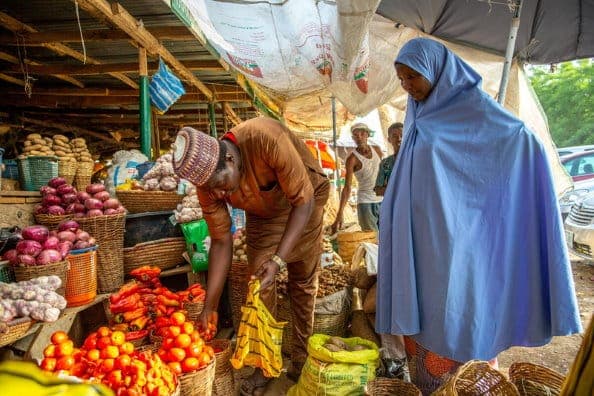
Nigeria's food markets stayed mixed last week, according to week-43 price surveillance carried by Useagrios across key commodities, with street-level data showing a modest decline of 1.6 per cent in maize prices, a 2.8 per cent rise in palm oil, and a 2.7 per cent drop in cashew nuts, movements that suggest domestic supply chains are transmitting relief and pressure in distinct channels even as official inflation data shows broad food-price deceleration.
The market-level movements matter because food dominates Nigerian consumption baskets and has been the single biggest driver of headline inflation over the past two years. September's National Bureau of Statistics food inflation reading said the year-on-year rate of increase had slowed to 19.59 per cent, its lowest in months, but that headline context still leaves food prices rising by double digits in aggregate, with the composition of those increases varying sharply by commodity and by region.
What individual commodities are telling us
Maize's 1.6 per cent weekly decline is a supply-side story. The dry-season harvest season is nearing in key producing states, and with locally available stock supplemented by white maize moving into urban markets, competition among traders has softened prices at the margin. Palm oil's 2.8 per cent increase points the other way: palm-oil supplies from the south-east and south-south have tightened seasonally as the peak harvest window closes, and industrial demand for palm-oil derivatives keeps paying up for quantity, which lifts prices even at the retail edge.
Cashew nut pricing, down 2.7 per cent, reflects demand weakness from the export market rather than domestic consumption dynamics. Nigeria's cashew exports depend heavily on Indian and Vietnamese processors, whose buying rhythm sets the farmgate price for the domestic trade, and last week's softness suggests those external buyers have filled their near-term inventories, leaving local traders to lower prices to move stock.
[irp]
Where pressure spots for consumers remain
The week's data places protein, nutrition-dense foods and processed staples, rather than grains, at the leading edge of Nigerian food-price pressure. With protein categories, including beef, poultry, eggs and fish, showing the largest cumulative price gains of 2026, ColdHubs, the solar-powered cold-storage social enterprise that keeps perishables fresh for small traders across the country, remains one of the more significant private infrastructure responses to post-harvest losses in the perishables value chain.
Storage and logistics remain the battleground. Nigeria's post-harvest losses across the tomatoes, plantain and vegetables categories have historically been measured in tens of per cent, and the persistence of seasonal volatility, evident in last week's palm-oil move, is partly a distribution problem rather than a production problem. Every logistics breakthrough that reduces spoilage acts as a supply increase that pulls prices down.
[irp]
The inflation-data backdrop
September's official reading, with food inflation at 19.59 per cent year on year, is worth reading carefully alongside the grass-roots data. Year-on-year rates measure the rate of change: a deceleration means prices are rising more slowly, not that they are falling, and Nigeria's food-price level remains far elevated compared with the pre-devaluation baseline. Week-43's modest declines in maize and cashew, alongside the palm-oil increase, illustrate how commodity-specific forces, harvest timing, export demand and logistics, can diverge from aggregate inflation trends.
Analytically, the divergence matters for policy. A monetary-policy stance calibrated against aggregate food inflation overshoots for some commodities and undershoots for others, and the fiscal levers that could relieve specific food categories, dry-season farming support, export restrictions and strategic reserve releases, are the ones that address supplier-side fundamentals directly.
[irp]
What to watch
Heading into the harvest ramp in November and December, key price markers include how quickly dry-season production delivers incremental supply, whether fuel-price movements at the depots last week, where petrol crashed across major hubs while diesel surged, feed through to transport costs for the vegetables and grains most sensitive to freight, and whether categories most exposed to imported inputs, fertiliser and tractor fuel included, see margin relief as the naira rate stabilises.
For investors in the agricultural value chain, maize production-linked plays, processing capacity and cold-chain infrastructure remain the areas where structural demand outpaces supply, and the week's market data suggest that the watchlist should focus on the dry-season harvest's arrival at urban markets, where scarcity pricing has been the most persistent feature of 2026's food inflation picture.
[irp]
Up next
NSIA Prize for Agriculture crowns Come Again Foods, Protein Kapital, Tryctor as winners
The NSIA Prize for Agriculture has named Come Again Foods, Protein Kapital and Tryctor as winners, with $277,000 in cash awards and a Pula Xcelerator pathway worth about $1.5m in growth support.
More in Agriculture
See all
Nigeria develops disease-resistant ginger to revive $730 million industry
New resistant planting materials could cut crop losses and lift exports, but commercial seed supply and processing gaps remain.
NAFDAC, agriculture ministry trade blame as unsafe food floods markets
Overlapping mandates and weak enforcement are allowing contaminated food into Nigerian markets, with serious health and economic costs.

Shettima sets up technical committee for wheat, staples, livestock
Vice-President Kashim Shettima has constituted a technical committee to develop interventions in wheat, staple crops and livestock, though no deadline or funding has been announced.
About the author
Tunde Balogun
Economics Correspondent
Tunde Balogun writes for BusinessPress.
More by Tunde Balogun